7 High-Impact Lead Nurturing Email Templates with Real Life Examples that Successful Brands Use

Summarize with


Last Updated:
Lead nurturing is often reduced to a swipe file of email templates. Pick one, paste it in, and expect momentum. That approach feels efficient, but it rarely builds impactful progression.
Templates on their own are static. What makes them powerful is the intent behind them. Used correctly, they offer structure, shape your tone, and clarify why an email exists in the first place. Every nurturing email should reduce uncertainty and guide a lead one step closer to meaningful engagement, without pressure.
This article is not a template dump. It is a practical look at what to send and how to send it
What is the Role of Email Templates in Lead Nurturing?
Lead nurturing emails sit between general communication and direct sales in the lead generation funnel. They are not broad newsletters sent to an entire list, and they are not immediate conversion pushes. Instead, they are intentional touchpoints designed to guide a lead from awareness to consideration in a logical progression.
What makes them different is structure. Each email has a purpose. Each message reflects the lead’s stage. Each interaction builds on the previous one. This is where templates become valuable. Most teams understand the theory of warming leads over time, but execution often feels unclear.
Used correctly, nurturing templates help you:
- Match content to the lead’s current questions and level of awareness
- Establish credibility without introducing premature sales pressure
- Deliver value that naturally encourages the next step
When emails are structured this way, the journey feels cohesive. Instead of receiving isolated messages, the lead experiences a connected sequence that reduces uncertainty and builds confidence over time.
Pro-Tip: For a broader strategic framework for any successful business, read this guide on lead nurturing process, strategies, and tactics.
B2B vs B2C Lead Nurturing Email Templates
Lead nurturing exists in both B2B and B2C contexts, but the approach differs because the audience, decision-making process, and engagement triggers are not the same. Understanding these differences helps marketers design emails that resonate and move leads forward effectively.
The core difference is in the purpose and intent of the buyers of that business.
- B2B lead nurturing emails focus on long-term relationship building, education, and trust with professional decision-makers. The goal is often to guide leads through a structured buying journey that involves multiple stakeholders.
- B2C lead nurturing emails prioritize immediacy, engagement, and personalized value. The goal is to connect emotionally, provide quick wins, and encourage actionable steps, often to drive purchases or ongoing engagement.
| Aspect | B2B Email Templates | B2C Email Templates |
|---|---|---|
| Audience | Professional decision-makers, teams, or businesses | Individual consumers or end-users |
| Goal | Build trust, demonstrate ROI, educate over time | Engage quickly, provide value, inspire action |
| Tone | Professional, informative, data-driven | Relatable, conversational, emotional |
| Content Type | Case studies, whitepapers, product demos | Tips, lifestyle guides, promotions, testimonials |
| Sequence Length | Longer, multi-step journeys | Shorter, faster-moving sequences |
| Decision Cycle | Longer, multi-stakeholder | Shorter, often individual-driven |
Recognizing these distinctions ensures that the templates you design for each audience are purposeful, stage-appropriate, and effective.
7 Types of Lead Nurturing Emails With Real-Life Examples
When we categorize nurturing emails, the most useful approach is by function rather than industry. Whether you are in SaaS, eCommerce, or professional services, the purpose behind the email determines its effectiveness.
Educational Lead Nurturing Email Template
Educational email templates sit at the beginning of most lead nurturing sequences. Their role is simple but critical: build clarity before building conversion. At this stage, leads are aware of a problem, but they are not fully confident about its scope, impact, or possible solutions.
These emails typically focus on:
- Explaining common mistakes or misconceptions
- Breaking down complex topics into simple insights
- Reframing a challenge in a way that feels actionable
- Offering small, practical takeaways that the lead can apply immediately
An educational email exists to reduce that uncertainty. It does not push a demo. It does not introduce urgency. Instead, it helps the reader think more clearly about their situation.
Real Life Educational Lead Nurturing Email Template: Gardener’s Supply Company

Why this Email Works?
- Starts a letter which addressing the readers of the email
- Ends with a hopeful wish of “Peaceful Solstice & holiday season.”
- Informs readers about the seasonal upgrade they are bringing
- Explains how Gardener’s supply works in the background
The effectiveness of educational email templates comes from restraint. By prioritizing value over persuasion, you position your brand as a knowledgeable guide rather than a vendor seeking attention. This builds trust, which is the foundation of every successful nurturing flow.
When used early in the sequence, educational emails create the context that later emails rely on. They prepare the lead to understand use cases, appreciate social proof, and respond to soft calls to action with greater confidence.
Use-Case Lead Nurturing Email
Use case or problem solution email templates come into play once a lead understands the problem and begins searching for workable answers. At this stage, awareness exists, but confidence does not. The lead needs proof that improvement is realistic and achievable.
These emails exist to make the solution tangible. Instead of explaining concepts, they demonstrate outcomes. They shift the conversation from theory to application.
Problem solution emails typically focus on:
- Presenting a clear and relatable challenge
- Showing how a specific approach addressed that challenge
- Highlighting measurable or visible results
- Connecting those results to a process that the reader can understand
Their strength lies in relatability. When leads recognize their own situation in the example, they move from passive interest to active consideration. The outcome feels attainable rather than abstract.
Used strategically after educational emails, this format deepens engagement. It transforms understanding into possibility, and possibility into momentum.
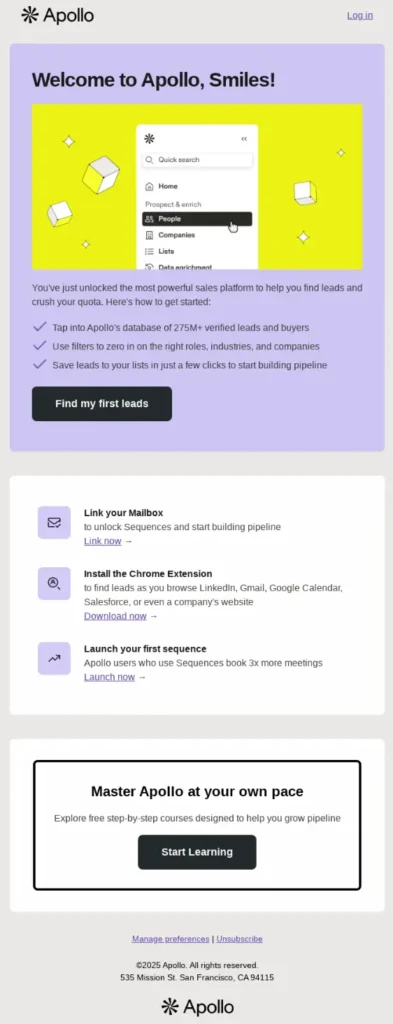
Real Life Use-Case Lead Nurturing Email Template: Apollo
Why this Email Works?
- Email tells the benefit of using Apollo with a concise solution to the problem
- Has a concise CTA that intice curiousity with the line “find my first lead”
- Explain the core benefits of using Apollo in problem-solving style
- Includes another CTA by saying “Start Learning,” suggesting a solution to “grow pipeline.”
Social Proof and Credibility Lead Nurturing Email Template
Trust is one of the biggest barriers in any nurturing journey. Even when leads understand the problem and see potential solutions, hesitation remains. They need reassurance that your claims are credible and that others have achieved real results.
Social proof email templates exist to reduce perceived risk. They validate your message through evidence rather than explanation. Instead of telling leads that your solution works, you show that it has worked for others.
These emails typically focus on:
- Highlighting measurable outcomes or improvements
- Sharing short testimonials or client insights
- Referencing recognizable brands or industries
- Demonstrating before and after scenarios in concise form
Timing is essential. Introducing credibility too early can feel disconnected if the lead has not yet identified with the problem. However, when placed after educational and problem-solving emails, social proof strengthens the narrative. It confirms that the approach you introduced is not theoretical but proven.
Used thoughtfully, social proof transforms curiosity into confidence and prepares the lead for deeper engagement.
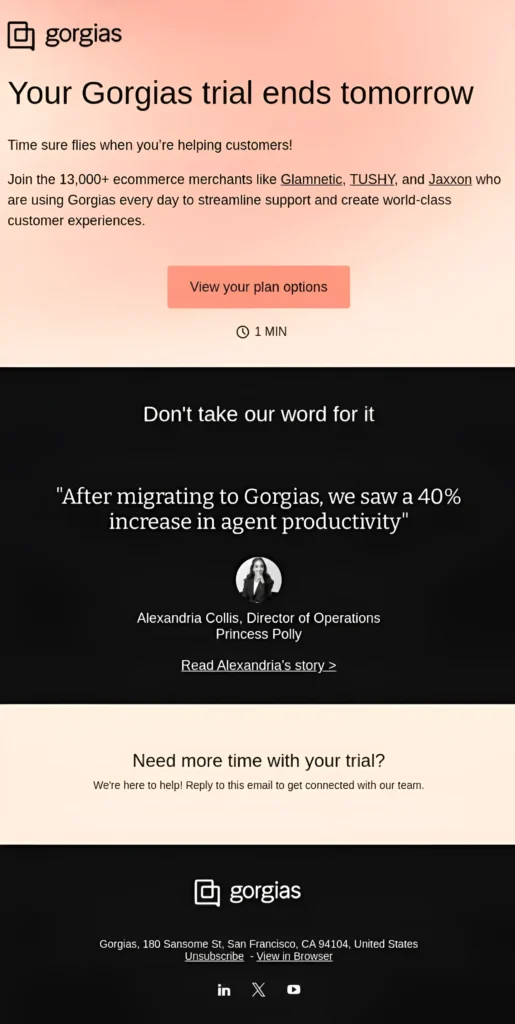
Real-Life Social Proof Lead Nurturing Email Template: Gorgias
Why this Email Works?
- Includes a credible social proof from a user in a different color to highlight the review
- Add the profession of the reviewer to build further credibility
- Guide readers to read the reviewer’s journey with Gorgias
- Shows review, brand information in the same color to build brand coherence psychologically
Engagement and Feedback Lead Nurturing Email Template
Engagement email templates are designed to assess readiness and encourage interaction. By this stage, leads have received value and context. What you need now is clarity about their level of interest and current priorities.
These emails exist to open a two-way conversation. Instead of delivering more information, they invite a response. That response becomes a signal you can use to guide the next step in your sequence.
Engagement emails typically focus on:
- Asking simple, direct questions about current challenges
- Confirming whether the topic is still relevant
- Offering options that allow leads to self-identify their needs
- Encouraging replies rather than clicks alone
Their value is twofold. First, they demonstrate attentiveness. You show that you care about relevance, not volume. Second, they generate insight. Replies and interactions reveal intent, making future emails more precise and personalized.
Used strategically, engagement emails transform passive readers into active participants and create natural branching points within your nurturing flow.
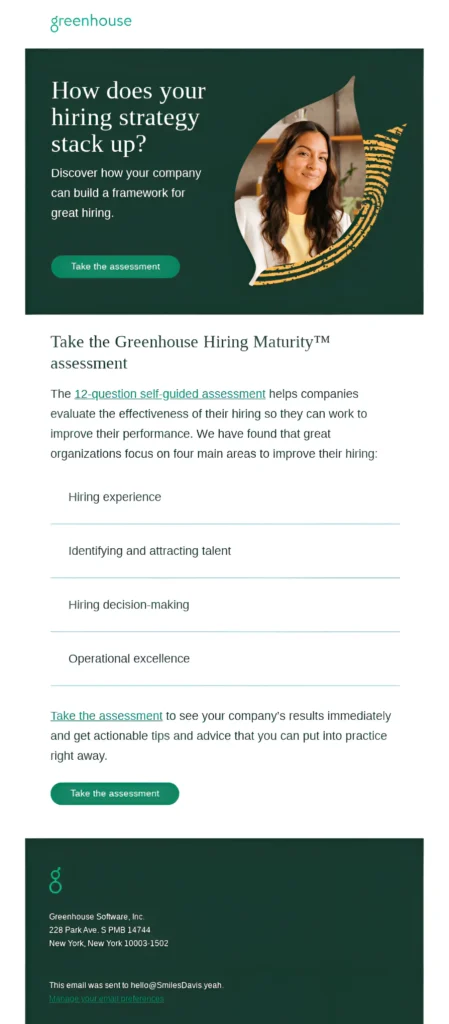
Real-Life Feedback Lead Nurturing Email Template: Greenhouse
Why this Email Works?
- Starts with a promise to evaluate the company’s effectiveness in hiring
- Add value first by saying how the Greenhouse evaluates based on answers
- Promises to show the company’s results immediately with accessible tips
- Begins with a catchy line saying, “How does your hiring strategy stack up?”
Soft Call-to-Action Lead Nurturing Email Template
Soft call-to-action email templates are designed to invite movement without forcing commitment. At this stage, the lead has gained context and trust, but may not be ready for a direct sales conversation. The goal is to encourage a small, meaningful step forward.
These emails do not push for purchase decisions. Instead, they guide leads toward low-pressure interactions that continue the learning process.
Soft CTA emails typically focus on:
- Offering practical resources such as checklists, guides, or worksheets
- Inviting leads to exploring a feature or concept more deeply
- Suggesting a next step that feels helpful rather than transactional
- Framing the action as optional and supportive
Their effectiveness lies in subtle progression. Rather than overwhelming the reader with urgency, they create incremental engagement. Each small action strengthens familiarity and confidence.
When used after education, problem solution examples, and social proof, soft CTAs feel natural. They extend the conversation and deepen the relationship without shifting abruptly into sales mode.
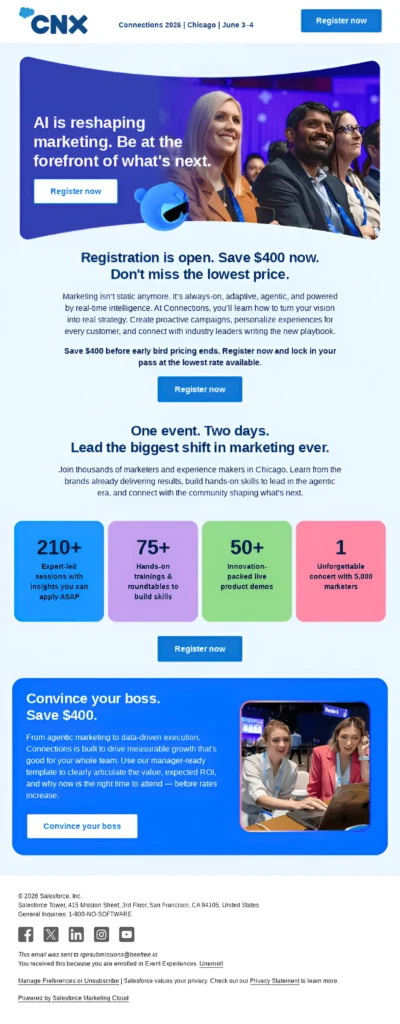
Real-Life Call-to-Action Lead Nurturing Email Template: Salesforce
Why this Email Works?
- Salesforce used the CNX connection to register leads who will be interested
- Promises what values attende will be getting with concise numbers
- Use CTA with a number that expresses how much money can be saved
- Start with the recent trend in AI to entice the receivers to register for the event
Webinar Invitation Lead Nurturing Email Template
Event and webinar invite email templates are designed to create interactive touchpoints within your nurturing sequence. After delivering value through content, inviting leads into a live or scheduled experience increases the depth of engagement.
These emails shift the format from passive consumption to active participation. Instead of reading insights, the lead joins a conversation, asks questions, and interacts in real time.
Event invite emails typically focus on:
- Presenting a clear and relevant topic tied to the lead’s challenges
- Emphasizing practical takeaways or actionable insights
- Highlighting limited time access or scheduled timing
- Making registration simple and low-friction
Their effectiveness comes from immersion. Live sessions and webinars build credibility through visibility and expertise. They also create momentum, since attending an event requires a higher level of commitment than clicking a link.
Placed strategically within a nurturing flow, event emails deepen trust and move engaged leads closer to meaningful decision-making.
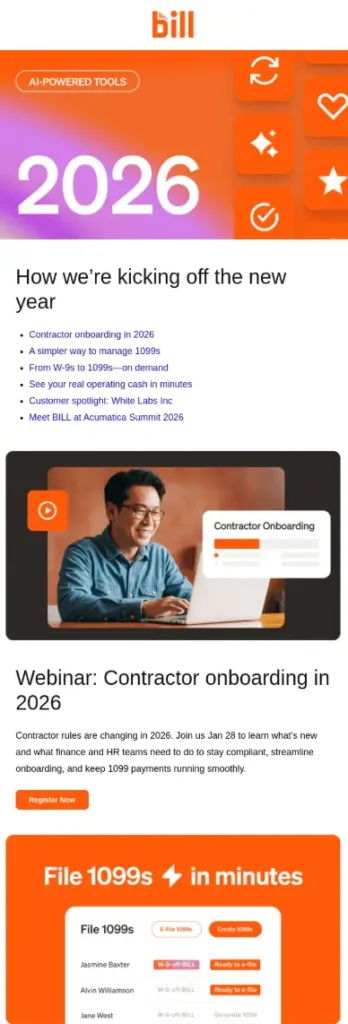
Real-Life Webinar Lead Nurturing Email Template: Bill
Why this Email Works?
- Start with a concise plan of how they are starting 2026 for maximum effect
- Explains the changes a team needs to stay compliant with onboarding
- Entice receivers with a CTA to increase cash flow with precision
- Mention the webinar as on demand webiner to increase further interest in attending
Resource and Tool Highlight Emails
Resource and tool highlight email templates are designed to provide tangible value while demonstrating expertise. After leads have gained awareness and seen possible solutions, these emails give them something practical they can apply immediately.
Rather than simply sharing information, these emails equip leads with tools, templates, or frameworks that solve problems. By offering actionable resources, you reinforce your brand’s authority and establish a sense of usefulness beyond words.
Resource emails typically focus on:
- Delivering practical assets such as templates, checklists, or calculators
- Demonstrating how these resources solve a specific pain point
- Highlighting the credibility or experience behind the resource
- Encouraging leads to engagement by applying the resource themselves
Their effectiveness lies in creating instant value. Leads experience a small win by using the resource, which strengthens trust and positions your brand as a partner in solving their challenges.
When sequenced after educational and problem-solution emails, resource-focused emails deepen engagement, provide proof of expertise, and subtly guide leads toward further steps in the nurturing journey.
Real Life Lead Nururing Email with Resource: Attentive
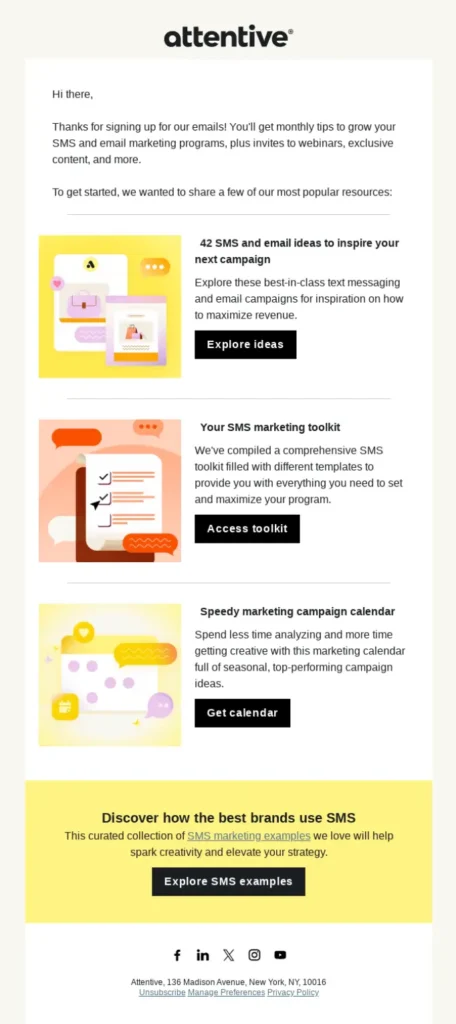
Why this Email Works?
- Shares resources as a solution to the problem Attentive solves
- Segments the resources like explore ideas, access toolkit, and get calendar
- Provides resources to explore sms examples for impactful marketing
- Engage receivers with a CTA for a case study on how the best brands use SMS
How These Templates Fit into a Lead Nurturing Sequence
Lead nurturing email sequences are the backbone of effective lead nurturing. A single email, no matter how well-crafted, can rarely move a lead meaningfully along the funnel. The real value emerges when multiple emails work together as a connected story, guiding leads step by step from curiosity to engagement.
This is how templates can fit into your nurturing sequence to make your lead nurturing more impactful:
- A single email rarely moves a lead; sequences turn individual messages into a guided journey.
- Combining educational, problem-solving, social proof, engagement, and soft CTA emails creates a natural progression.
- Each email should build on the previous one, guiding leads step by step without feeling rushed.
- Timing and order matter, and behavior signals like clicks or replies help determine the next step.
- Observing engagement allows you to adjust the sequence so each email feels relevant and purposeful.
- Thinking in sequences keeps the nurturing flow cohesive and reduces friction for leads.
- Leads progress differently; sequences let you create paths that match varying readiness levels.
- Sequenced emails strengthen trust by showing consistency and thoughtfulness over time.
- Small, incremental actions in each email prepare leads for larger commitments later.
- Even without automation, planning sequences ensures each email contributes to a bigger narrative.
- Sequences also reveal gaps in content or messaging, helping you refine future nurturing campaigns.
Leads respond best when each email feels purposeful, connected, and timed to their journey. Sequences make that possible.
Common Mistakes When Using Lead Nurturing Templates
Even the best templates can fail when context is ignored. A single email, no matter how well-written, can feel irrelevant if it is sent at the wrong time or without regard for the lead’s stage.
Common mistakes include:
- Sending emails out of sequence or ignoring where the lead is in their journey
- Using sales-heavy CTAs before trust and relevance are established
- Over-emailing, which can overwhelm leads and increase unsubscribes
- Treating all leads the same, instead of segmenting based on behavior or engagement
- Measuring success only by opens or clicks rather than meaningful progression
- Ignoring engagement signals and failing to adjust content or timing accordingly
- Providing generic content instead of tailoring emails to the lead’s specific interests or challenges
- Skipping follow-ups after partial engagement, which leaves momentum untapped
- Neglecting the flow between email types makes the sequence feel disjointed
- Overloading emails with too much information, reducing readability, and focus
- Relying solely on templates without adapting tone or voice to the brand and audience
These errors mainly come from misaligned intent. Every email should serve a specific purpose, moving the lead closer to engagement while respecting their pace. Without this alignment, even well-crafted messages fail to connect.
Key Takeaways for Email Marketers: How Lead Nurturing Templates Work
Using lead nurturing templates effectively is less about copying content and more about applying strategy. These emails only work when they are purposeful, stage-appropriate, and responsive to your leads. Keep these points in mind:
- Templates are guides, not instructions: They provide structure and tone, but you must tailor each email to your audience and context.
- Align emails with lead stage and intent: Early leads benefit from educational content, while warming leads respond better to problem-solving and social proof.
- Combine email types strategically: A mix of educational, problem-solving, social proof, engagement, and soft CTA emails ensures a coherent journey.
- Use tools to support, not replace strategy: Platforms like FluentCRM can help manage sequences and track signals, but the strategy behind your emails drives results.
- Avoid over-emailing: Too many messages too quickly can overwhelm leads and increase unsubscribes. Maintain proper email frequency.
- Measure progression, not just opens: Focus on whether leads move forward in the funnel, not only if they opened the email.
- Personalize where possible: Even small personalization, like addressing the lead by name or referencing their recent activity, increases engagement.
Maintain consistency in tone and value. Each email should feel like part of a connected conversation rather than an isolated message.
Templates Are Starting Points, Not Systems
Templates should be seen as beginnings. They help you start crafting a message, finish a sequence thoughtfully, and maintain intent throughout the nurturing journey. They are not rigid rules, nor are they complete automation systems.
By focusing on function over form and intent over design, marketers can bridge the gap between strategy and execution. The emails you send will not only be opened but will guide leads forward, preparing them for the next stage in your funnel.
Lead nurturing templates are most valuable when used as part of a coherent, responsive sequence. They are the starting points for meaningful engagement, not just content to fill inboxes.
Samira Farzana
Once set out on literary voyages, I now explore the complexities of content creation. What remains constant? A fascination with unraveling the “why” and “how,” and a knack for finding joy in quiet exploration, with a book as my guide- But when it’s not a book, it’s films and anime.
Table of Content
Related Articles and Topics
-
How to Use Video Lead Scoring for a Product Launch Waitlist [Complete Guide]
You put together a teaser video for the thing you’re about to launch. It goes…
-
How to Create a Newsletter Archive on WordPress within 5 Minutes!
You send a newsletter to your subscribers, once they reach their inboxes and read it…