Hard Bounce vs Soft Bounce: What They Mean and What to Do Next

Summarize with


Last Updated:
If you are in email marketing for long enough, you probably already know ‘bounce’ is a part of the game.
The real problem is when people treat every bounce the same. They are not the same. A hard bounce usually means the address is dead. A soft bounce usually means the door is shut for now, not forever.
If you blur that line, you end up cleaning the wrong contacts, reading the wrong signals, and making deliverability worse than it needs to be. That is why this topic matters so much. Let’s dive in.
What a Bounce Actually is
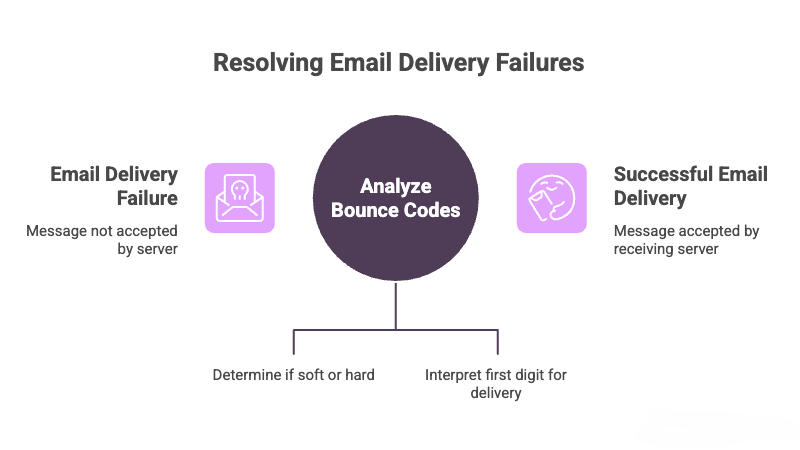
A bounce is an email delivery failure that occurs when a message sent to a recipient cannot be successfully accepted or delivered by the receiving mail server. In such cases, the server returns a response code or notification explaining why delivery failed.
These failures are generally classified as temporary (soft bounces) or permanent (hard bounces) based on SMTP status codes. RFC 3463 defines the status code model and says the first digit indicates whether delivery succeeded, failed permanently, or failed temporarily.
Hard Bounce: The Address is Not Coming Back
A hard bounce happens when an email fails permanently because the destination address cannot receive messages. Unlike temporary delivery issues, a hard bounce signals that the problem is not expected to resolve on its own. The address is invalid, unavailable, or permanently unable to accept mail.
In practical terms, this is not a retry problem. It is a list hygiene problem.
When marketers ignore hard bounces and keep sending anyway, mailbox providers may interpret it as poor sending practices. Over time, that can hurt your sender reputation, lower deliverability, and make it harder for valid subscribers to receive your emails.
Common Hard Bounce Causes
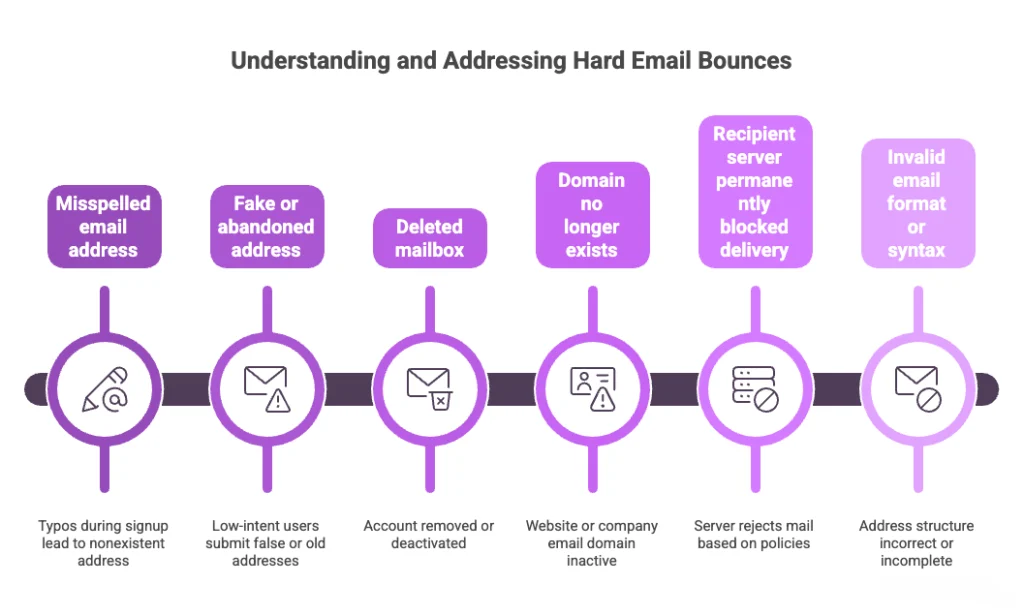
A few reasons why hard bounce happens are given below:
- Misspelled email address: Typos during signup may lead to a nonexistent email address
- Fake or abandoned address: Low-intent users sometimes submit false addresses or old inboxes they no longer use.
- Deleted mailbox: The account once existed but has since been removed or deactivated.
- Domain no longer exists: The website or company email domain is no longer active.
- Recipient server permanently blocked delivery: Some servers reject mail based on policies, reputation issues, or blocked senders.
- Invalid email format or syntax: The address structure itself is incorrect or incomplete.
If a contact hard bounces, you should stop sending to that address. Not later. Not after one more campaign. Stop.
Soft Bounce: The Address May Still Be Fine
A soft bounce happens when an email cannot be delivered at the moment, even though the recipient’s address is usually still valid. Unlike a hard bounce, the issue is temporary. Once the blockage clears, the message may be delivered successfully on a later retry. That distinction matters.
A soft bounce does not usually mean your list is bad. It means something in the delivery path is temporarily getting in the way. In practical terms, this is not a cleanup problem. It is a monitoring problem.
Soft bounces are often early signals. A few are normal in every campaign. Too many can point to technical issues, poor email setup, or mailbox providers becoming cautious about your sending behavior.
Common Soft Bounce Causes
Here are the reasons for a common soft bounce that any email marketer may face:
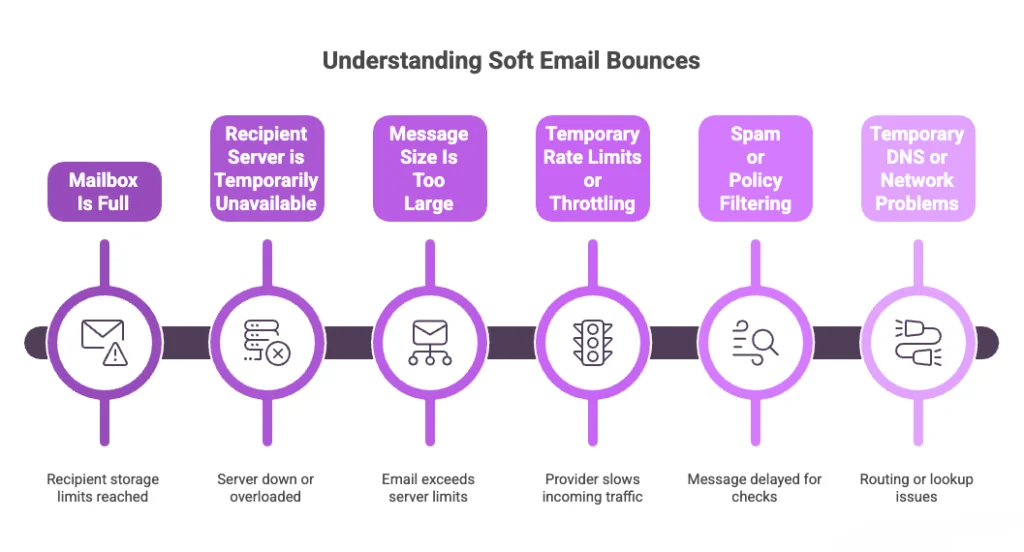
- Mailbox Is Full: The recipient has reached storage limits and cannot accept new messages until space is cleared.
- Recipient Server is Temporarily Unavailable: The receiving server may be down, overloaded, under maintenance, or responding slowly.
- Message Size Is Too Large: Oversized emails, heavy attachments, or bulky HTML designs may exceed server limits.
- Temporary Rate Limits or Throttling: Some mailbox providers slow incoming traffic when send volume is high or reputation is uncertain.
- Spam or Policy Filtering: The message may be delayed or deferred while authentication, content, or reputation checks are performed.
- Temporary DNS or Network Problems: Short-lived routing or domain lookup issues can interrupt delivery attempts.
Which Bounce is More Concerning and Why?
Hard bounce is more concerning than soft bounce.
Hard bounce usually signals permanent delivery failure. Mailbox providers notice when too many of your emails are sent to unreachable contacts. It can suggest weak data collection, outdated lists, careless targeting, or poor list maintenance. None of those signals builds trust.
As hard bounce rates increase, sender reputation often declines. That can lead to lower inbox placement, more aggressive spam filtering, and weaker campaign results over time.
In simple terms, repeatedly sending to dead addresses makes you look careless.
Pro-Tip: You need to clean your contact list regularly. You can clean your contact list with FluentCRM. Read this blog to know how.
What to Do: Soft Bounce vs Hard Bounce
| Soft Bounce | Hard Bounce |
|---|---|
| Delivery failed temporarily, but the address may still be valid. | Delivery failed permanently because the address is invalid or unreachable. |
| Let the system retry delivery automatically. | Stop sending to the address immediately. |
| Check common temporary issues like full mailbox or server downtime. | Mark the address as invalid or bounced in your list. |
| Review authentication (SPF, DKIM, DMARC) if failures repeat. | Investigate whether the address came from poor or inaccurate signup data. |
| Monitor repeat soft bounces over time. | Check common temporary issues like a full mailbox or server downtime. |
| If patterns persist, treat as inactive or risky contact. | Fix the source of bad data to prevent future hard bounces. |
Why ESPs Do Not Treat Bounces the Same Way
An ESP (Email Service Provider) is the platform businesses use to send marketing or transactional emails, manage subscriber lists, automate campaigns, and monitor deliverability.
Different ESPs do not always classify bounces the same way. This is where many teams become confused.
When an email fails, the receiving server returns a response code or rejection message. In theory, that sounds straightforward. In practice, those responses are often inconsistent, vague, or highly technical. Each ESP then interprets that raw feedback through its own internal logic.
As a result, the same issue may appear under different names depending on the platform. One tool may call it a hard bounce, another may mark it as an invalid address, while another may group it under blocks or technical failures.
The underlying problem may be identical. Only the label changes.
That is why experienced senders do not fixate on terminology. They focus on the real reason the message failed. They ask these questions to find out the underlying issue:
- Was the address invalid?
- Was the mailbox temporarily unavailable?
- Was the server rejecting mail due to policy, reputation, or volume?
Bounce labels are reporting categories. Root causes are what matter.
How to Prevent Bounces Before They Happen
Most bounce issues are not random; they are predictable. They start earlier in the system, usually at the point of data collection or list growth. The best deliverability strategy is not reacting to bounces after they happen, but reducing the chances of sending to bad addresses in the first place:
1) Use confirmed opt-in: Require users to verify their email after signup, since this step filters out typos, fake addresses, and low-quality signups before they enter your list, reducing bounce rates from the start.
2) Protect your forms: Use CAPTCHA and other anti-abuse checks on signup forms to prevent bots and fake emails from entering your list, since poor-quality signups directly increase bounce rates and weaken deliverability.
3) Stop buying or scraping lists: Avoid purchased or scraped email lists, since they often contain invalid, low-quality addresses that lead to high bounce rates, poor engagement, and damaged sender reputation.
4) Authenticate your sending domain: Set up proper email authentication (SPF, DKIM, DMARC) to prove your emails are legitimate and improve deliverability, since unauthenticated domains are more likely to be rejected or filtered.
5) Clean old, dead contacts: If a contact has been inactive for a long time, do not let them stay on your list indefinitely. Regularly clean your email lists, since unused inboxes often become invalid over time.
6) Watch for repeat soft bounces: One soft bounce can happen. Several soft bounces from the same contact are a signal. Maybe the inbox is dead. Maybe the server is rejecting you. Either way, it deserves a review.
7) Google & Yahoo Deliverability Rules: Modern mailbox providers like Google and Yahoo have updated their deliverability rules. Make sure to implement Gmail and Yahoo deliverability rules in your email.
8) List-Unsubscribe Header: Always include a proper list unsubscribe header in your emails, since it is a required deliverability standard that lets users opt out cleanly instead of marking messages as spam, helping protect overall domain reputation.
Maintaining these steps can help you prevent bounce before they happen.
Bounces Are Signals, Not Just Numbers
Bounce rates are often treated as a reporting metric, but that view is too passive. In reality, bounces are feedback from the delivery system. They reveal the health of your email list, the quality of your acquisition sources, the trust level of your sending domain, and the strength of your overall email setup.
Ignoring that feedback creates long-term problems. Campaigns become noisier, deliverability weakens, and performance data becomes less reliable. A large list filled with invalid or unresponsive addresses is not an advantage; it is just a larger version of the same underlying issue.
The key takeaway is simple: hard bounces are dead ends and should be removed, while soft bounces are signals that need attention and investigation. When bounce handling is built into your workflow instead of treated as an afterthought, your email system stays healthier, more stable, and far more effective over time.
Samira Farzana
Once set out on literary voyages, I now explore the complexities of content creation. What remains constant? A fascination with unraveling the “why” and “how,” and a knack for finding joy in quiet exploration, with a book as my guide- But when it’s not a book, it’s films and anime.
Table of Content
Related Articles and Topics
-
How to Create a Newsletter Archive on WordPress within 5 Minutes!
You send a newsletter to your subscribers, once they reach their inboxes and read it…
-
New Gutenberg Editor: The Email Builder WordPress Users Always Wanted in FluentCRM
If you’re a WordPress user, isn’t it satisfying to write in Gutenberg? You click the…