
The Automation Tax That Never Appears on an Invoice

Summarize with


Last Updated:
Imagine you run a business consultancy in Europe. Your clients care about GDPR, and your team needs to know what each person submitted, consented to, and received.
If your contact activity, consent history, and other data sit in different services, you’re paying for more than the systems.
Let’s say you have a lead who fills out a form but never gets the expected follow-up. In a setup with several connected tools, finding the cause can mean checking the form, the connection, the contact record, and the sending step.
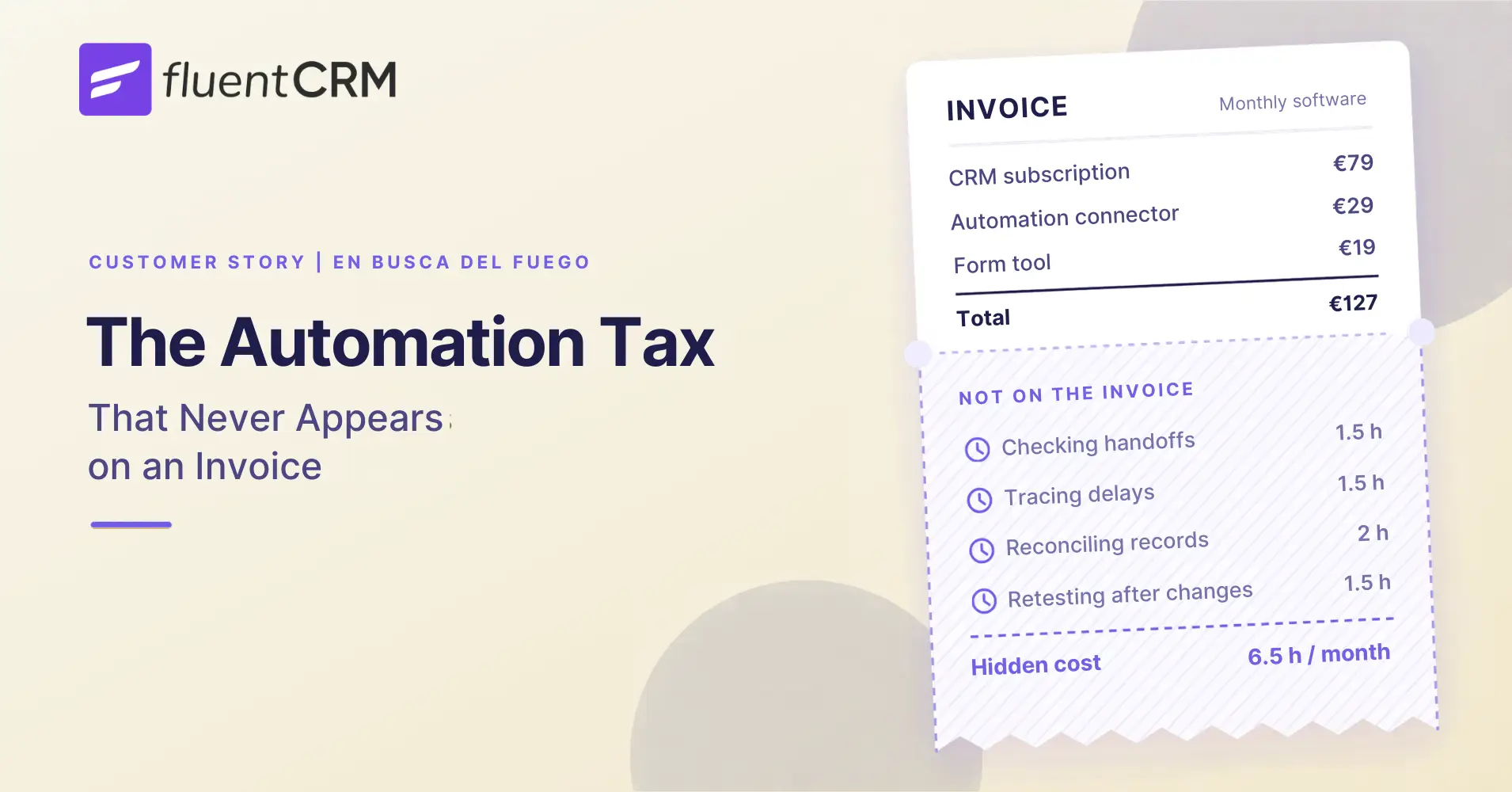
Your software invoice lists the tools. It does not list the time spent tracing that path. That recurring work is the automation tax: the time it takes to keep connected systems working as intended.
For En Busca del Fuego, a boutique business consultancy and online school based in Spain, hidden maintenance mattered alongside a growing software bill. Its experience shows why the price of automation is harder to judge from subscriptions alone.
Meet En Busca del Fuego
Founded by Jorge de los Reyes, En Busca del Fuego is a boutique business consultancy and online school based in Spain. It works with entrepreneurs, creators, and companies in Spanish and English, combining legal and business advice with education.
That mix creates long-term relationships. Someone may learn from the school, book a consultation, and later need client support. The team needs to understand the person’s activity and consent history across those interactions.
The Cost of Keeping Disconnected Tools in Sync
For about four years, En Busca del Fuego used ActiveCampaign alongside Zapier and custom WordPress code to connect marketing with its website and client workflows. Jorge estimated that reaching 50,000 contacts, including non-paying leads, could cost €14,000–€18,000 a year.
As he put it:
This structure penalized growth at the early and experimental stages of digital businesses.
Jorge de los Reyes, Founder, En Busca del Fuego
In his account, cross-tool integrations also introduced delays and administrative work. Consent records spread across services reduced visibility for the legal team. The estimate made software spend visible; the work of maintaining those connections was harder to price.
For a business with a similar setup, that work can show up in four places:
1. Confirming Each Handoff
A form submission was only the start. Someone had to check if the right information reached the contact record and that the expected follow-up happened. With several services involved, there was no single place to see the whole path.
2. Finding Where a Delay Began
If an update arrived late or an automated step behaved unexpectedly, the team had to check the form entry, the connection, the contact rule, and the sending step in turn. Finding the cause was a work of its own; fixing it and checking the path again took more time.
3. Reconstructing a Contact’s History
Keeping GDPR consent trails across multiple tools required complex integrations, and it reduced visibility for En Busca del Fuego’s legal team. In Jorge’s words:
“What should have been a transparent, auditable process became fragmented, increasing both risk and administrative workload.”
Jorge de los Reyes, Founder, En Busca del Fuego
When records live in separate services, answering a question about one person means matching those records accurately rather than simply opening one complete history.
4. Retesting After Routine Changes
A new form field, course, service, or site update could affect a later step. In a setup with several connections, that used to require checking the journey again to see whether records and follow-ups still line up.
Those checks, investigations, and record reviews took staff time alongside the rising software cost. The tool invoices showed the subscriptions; they did not show the hours spent keeping the systems working together.
The Hunt for a Meaningful Alternative
Once En Busca del Fuego found out how much their system could cost them, they started looking for a solution that wouldn’t just help them scale, but also reduce the overhead they were incurring behind the scenes.
As a consulting firm operating globally under strict EU legal standards, they needed a system that could give them total ownership of their data, full transparency over user interactions, and native integration with their WordPress infrastructure.
They were mainly looking for three things: control, compliance, and coherence.
They evaluated several alternatives, including HubSpot and Mautic. In Jorge’s words,
“Each had strengths but none offered the same balance of open data access, flexibility, and technical consistency across the entire stack.”
Jorge de los Reyes, Founder, En Busca del Fuego
In general terms, HubSpot offers a broad CRM and marketing toolkit, although contact records live in a separate hosted platform. Mautic can be self-hosted, which addresses ownership more directly, but it is still a separate application to run and connect with WordPress workflows.
Each choice posed a different tradeoff for a consultancy already running its website and client workflows in WordPress.
FluentCRM and the Fluent Ecosystem: The System That Reduced the Automation Tax by 60%
While En Busca del Fuego was considering their options, a certain WordPress plugin stood out: FluentCRM.
With its contact management capabilities, direct integrations and self-hosted nature, FluentCRM was already a good deal. And the Fluent Ecosystem with Fluent Forms, Fluent Support, and Fluent Community and flat yearly pricing meant fewer external connectors and excellent future scalability.
The Fluent ecosystem stood out for:
- Full data ownership and privacy-first design: All customer data resided within their own infrastructure, so consent records and logs stayed where their legal team could audit them under GDPR and Spain’s LOPDGDD.
- Limitless scalability: No pricing penalties for growth or audience size, so they could scale their business without worrying over any growth tax.
- Native WordPress integration: Direct communication between the Fluent modules and their internal workflows. This helped them efficiently handle data in terms of access management, data flows and more.
- Fast and transparent support: Fluent ecosystem’s fast support and community meant direct access to the development team, clear roadmap, and strong community feedback loop.
- Unified philosophy across the suite: Every Fluent product followed the same logic, UX, and data structure, ensuring operational harmony for their team.
With FluentCRM, they were finally able to centralize automations, marketing workflows, client segmentation, and compliance management inside their server environment. Jorge summed up the change in one line:
“No external connectors, no opaque third parties, and no unpredictable cost scaling.”
Jorge de los Reyes, Founder, En Busca del Fuego
En Busca del Fuego saw a values match, too: privacy, autonomy, and sustainability were principles En Busca del Fuego taught and implemented for its clients. And the Fluent ecosystem is designed for digital businesses who value those.
The Result: 60% Less Time Spent in Campaign Setup and Maintenance
After the move, Jorge described the effect on campaign setup and maintenance:


The 60% reduction describes En Busca del Fuego’s campaign setup and maintenance time after its particular migration. However, results will depend on each team’s tools and operating model.
How to Calculate Your Automation Tax?
Just as En Busca del Fuego, your business may have one or two optimization problems. If that’s the case, you need to start with one live journey rather than a full stack inventory.
Choose a path that matters to your business, such as enquiry to consultation or course signup to the first lesson.
Map what should happen at each step, then compare it with the work required to keep the path running. If you have a marketing automation strategy, use it as a starting map.
| Record | What to write down |
| Each step | The event, the system that receives it, and the next action expected. |
| Each handoff | What moves between systems and how the team confirms it arrived. |
| Exceptions | Recent missed or delayed actions, duplicate records, and manual corrections. |
| Changes | Time spent updating the workflow when forms, fields, offers, or services changed. |
| Ownership | Who notices a failure, who repairs it, and who responds to anyone affected. |
Review recent tickets, task notes, and change requests. For the next month, log the time spent checking, repairing, and changing this one journey. Keep new feature work separate; the figure you want is the time required to maintain what your business already runs.
The calculation is simple:
Monthly maintenance cost = hours spent maintaining the journey that month × the team’s loaded hourly cost.
Use a loaded rate that includes pay and relevant overhead, or the cost of contracted hours and keep your software bills beside that number, not inside it.
Suppose a team spends 90 minutes a week maintaining one journey. Across 52 weeks, that’s 78 hours. At an illustrative loaded cost of €50 per hour, the work represents €3,900 a year, or about €325 a month before software fees.
Your actual figure will depend on your team, tools, and how often that journey changes.
That estimate gives you a fairer basis for deciding whether to keep a connection, improve how it is monitored, or change the workflow.
Are You Paying More for Automation Than What Shows Up on Your Invoice?
En Busca del Fuego’s story proved that the true cost of software isn’t just the subscription fee, it’s the hidden time, complexity, and ongoing maintenance required to keep disconnected systems in sync.
If you are running your business on WordPress, you don’t have to keep paying this automation tax.
By bringing your marketing automation, contact management, and customer history directly into WordPress with FluentCRM, you eliminate expensive third-party connectors, ensure 100% data ownership, and gain complete control over your growth.

Nazir Himel
Product Marketing Lead
Hey! I’m an inbound marketing specialist focused on email marketing automation. I love turning complex features into clear, user-centric messaging and when I’m not shaping product stories, I’m experimenting with content frameworks, conversion journeys, and helping others communicate value without sounding salesy!
Table of Content
Related Articles and Topics
-
2X Revenue in 1 Year: How FluentCRM Quietly Became the Biggest Agency Growth Machine
Behind the curtain of glamour, the digital marketing agency landscape is fiercely unforgiving. Most agencies…
-
Jose Luis Duron: From a Radio Station Manager to an Entrepreneur and Business Consultant
Back in the early 2000s, Jose Luis Duron was working as a radio station manager…