


How to Market Online Courses the Right Way

Summarize with


Last Updated:
The e-learning industry is growing faster than ever. The global online education market is projected to reach$221.71 billion in 2026, and it is still climbing. If you have the skills to build an online course, you have a real chance to profit from this trend.
But here is the catch: even the best course is worthless if no one enrolls.
That is why marketing comes first. Ideally, you should have a plan before you record a single lesson.
Key Takeaways
- Marketing comes before creation. Plan how you’ll reach students before you record your first lesson.
- Own your platform, don’t rent one. Marketplaces like Udemy can take 30% to 80% of your profit and keep your student relationships. A self-hosted WordPress site lets you keep nearly all your revenue and your audience.
- Build your audience first. Grow a social media following with helpful content before launch, so you have people to sell to on day one.
- Community drives completions. Courses with an active community see completion rates of 70% to 85%, versus 5% to 15% for self-paced courses alone.
- Automate your email. Use FluentCRM to handle welcome, payment, and progress emails on autopilot.
- Let social proof sell for you. Collect reviews and success stories, then showcase them prominently to convert hesitant visitors.
Maybe you already built your course. Maybe you are still planning it. Either way, you have come to the right place. This guide walks you through a modern, tool-driven workflow to market your online courses the right way.
Let’s start with the essentials.
Before You Market: The Essentials
Before you promote anything, set your foundation. These pieces make every step that follows easier.
Decide Where You Will Sell: Marketplace or Your Own Platform
This is the first big decision, and it shapes everything else.
You can sell your courses on a third-party marketplace like Udemy, Coursera, or Skillshare. This is the easiest way to start. The platform handles hosting, payments, and even some marketing, and it puts your course in front of a large built-in audience.
But that convenience comes at a steep price. Marketplaces take a large cut of every sale. On Udemy, for example, instructors keep only 37% of organic marketplace sales, which means the platform keeps 63%. Depending on the platform and how the sale happens, your cut of the profit can shrink by anywhere from 30% to 80%.
There is a bigger cost too. On most marketplaces, you do not own your student relationships. You cannot build a mailing list, you do not control pricing, and the platform can discount or remove your course whenever it wants.
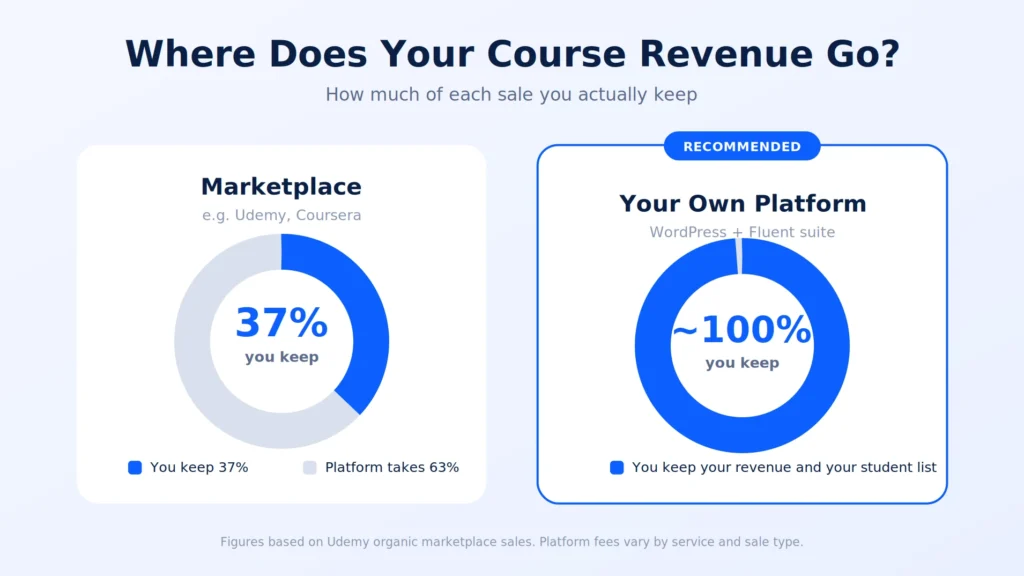
The alternative is to sell from your own website. You keep close to 100% of your revenue, you set your own prices, and you own your student list for life. It takes more setup, but it builds a real asset instead of renting space on someone else’s platform.
Our recommendation: many creators use a marketplace as a discovery channel while selling their main courses on their own platform. This guide focuses on building that platform, because that is where the long-term profit and control live.
Set Up WordPress
WordPress powers your entire course business, so start here. Use self-hosted WordPress.org, not WordPress.com, so you own your content and control your tools.
You will need three things to get going: a domain name, reliable hosting, and a WordPress install. Once that is live, you have a home base for your courses, your content, and your community.
Choose Your Tools
The right tools save you time and money. This workflow runs on the Fluent suite, a connected set of plugins for WordPress that handle courses, payments, video, email, and social proof:
- FluentCommunity to build and manage your courses and community
- FluentCart to sell your courses and handle payments
- FluentPlayer to stream your course videos
- FluentCRM to automate your email marketing
- WP Social Ninja to display reviews and social proof
Because these tools work together inside WordPress, you avoid the mess of stitching together five separate services.
Know Your Ideal Students
Your first real move is defining your audience. You need to know who they are and what they want. Start by segmenting them across a few criteria:
- Age group
- Interests
- Pain points they face
- Typical budget
- Platforms and resources they prefer
- Influencers they follow
Once you know your students, you can pick the right platforms, use the right language, and make the right promise. You can also shape your pricing and positioning to match.
Define Your Unique Value Proposition
The e-learning market is crowded. Buyers get overwhelmed by choices fast.
Clear, valuable messaging is the only way to help people find what fits them. When you state what makes your course unique, you stand out and give visitors a reason to choose you.
Focus on Outcomes, Not the Course
Marketing a generic “Beginner photography course” is hard. Promoting “Go from zero to your first photo project in three weeks” is much easier.
New students come for results and stay for the teacher. So focus your messaging on the outcome, not the course itself. Promise students something they want, then get them across the finish line.
Set a Promotion Budget
This one is less exciting, but it matters. If your budget is tight, cut the expensive channels and lean on free ones to grow steadily.
No matter the size of your budget, set aside some for the basics: content creation, video hosting, an email tool, and a landing page setup. If you can spare more, paid ads can build brand awareness in weeks instead of months.
Set Your Goals and Success Metrics
Decide what winning looks like before you start. Pick a few clear targets, like enrollment numbers, revenue, or email list size.
When you know your metrics, you can tell what is working and where to adjust.
The New Workflow: 9 Steps to Market Your Online Courses
Today’s e-learning market is competitive. Thousands of instructors are shipping courses every month. To stand out, you need a system. Here is a step-by-step workflow that takes you from zero audience to steady enrollments.
1. Build Your Social Media Presence First
Start building an audience before your course is ready. Set up profiles on YouTube, Facebook, Instagram, and TikTok, plus any other platform your students use.
Then post helpful resources consistently. Share tips, short lessons, behind-the-scenes clips, and quick wins tied to your topic. The goal is simple: become useful before you ask anyone to buy.
By the time your course launches, you will have an audience that already trusts you.
If you have room in your budget, paid social ads can speed this up. Target people by age, interests, and habits to reach the right students faster.
2. Launch Your Course Website
Next, build a website that showcases all your courses in one place. This is where interested followers become paying students.
UseFluentCommunity to create and manage your courses. It gives you a Gutenberg-based course builder, lessons, progress tracking, quizzes, and a member experience built right into WordPress. If you want a deeper look at why it works so well for course creators, this guide on the best course plugin for WordPress breaks it down.
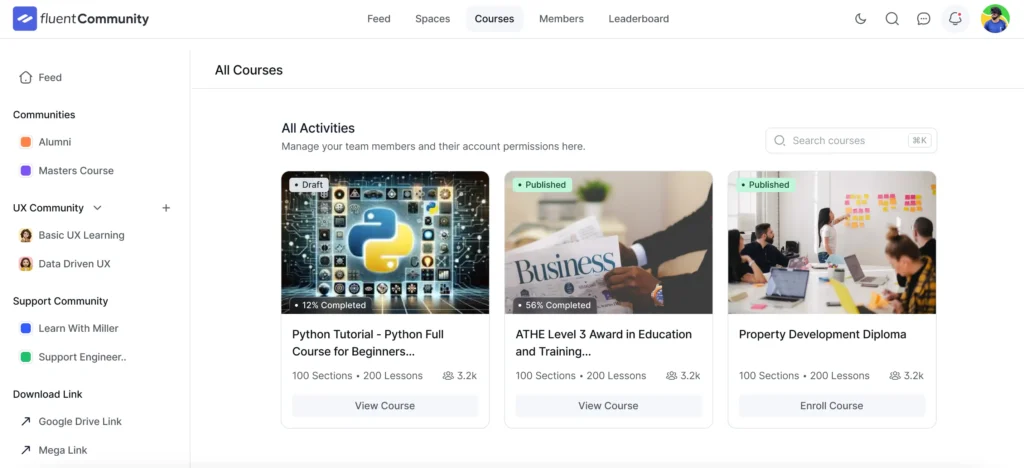
Use FluentCart to monetize your courses. Set up your pricing, checkout, payment gateways, and other configurations so students can buy in a few clicks.
Use FluentPlayer to showcase your course videos. It streams from YouTube, Vimeo, Cloudflare R2, or almost any other source, so you keep full control over how your lessons look and play.
Together, these three tools turn your website into a complete course platform without a pile of disconnected plugins.
3. Start a Community With Learner Spaces
A course is better with a community around it. The data backs this up: the average self-paced course sees completion rates between 5% and 15%, but courses with an active community report completion rates of 70% to 85%. Learners who feel connected finish more lessons, leave more reviews, and come back for your next course.
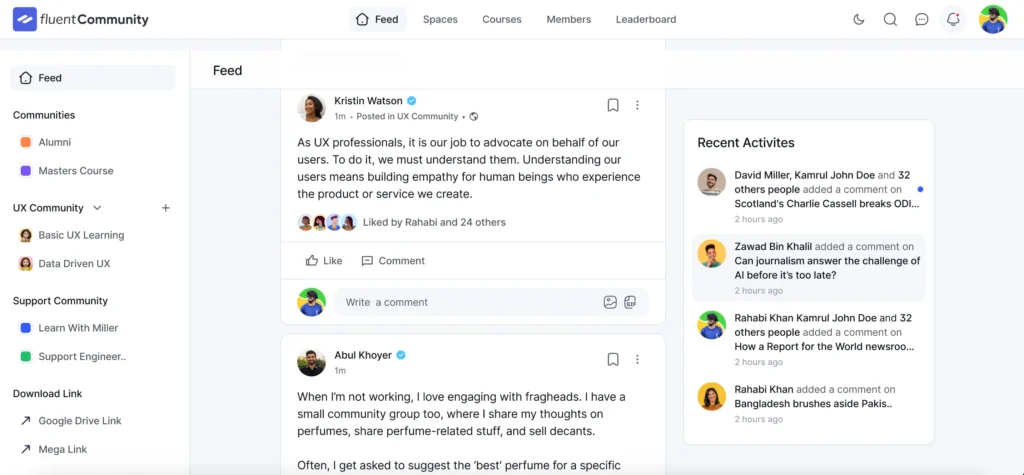
Use FluentCommunity to start a community and add several spaces for your learners. You might create spaces for each course, for general Q&A, for wins and progress, and for feedback.
These spaces turn quiet buyers into active members who help each other and promote your course for you. For a full walkthrough, see this guide on how to build a course community.
4. Automate Your Email With FluentCRM
Email is one of the most powerful ways to market a course, and automation makes it effortless. FluentCRM already powers email marketing for 50,000+ active installations, and it lives entirely inside your WordPress dashboard.
Install FluentCRM and set up contact segmentation, tagging, and lists so you can reach the right people with the right message. Then automate your email triggers, including:
- Welcome emails for new subscribers
- Payment and receipt emails
- Community emails that pull members back in
- Progress-based emails that congratulate students and nudge those who stalled
- Other transactional emails
Once these run on autopilot, every new contact gets a smooth, personal experience without extra work from you.
5. Reach Out to Instructors and Influencers
Someone who already succeeded in your space knows things you do not. Reach out to other instructors and influencers, and talk with them about your courses.
Ask for honest reviews. If it fits, ask them to tell their audience about your course too. A blogger who covers your topic but does not sell a course can make a great partner, since their readers are your ideal students.
Save the reviews you collect here. You will put them to work in Step 8.
6. Import Existing Contacts and Run a Campaign
You may already know people who need your course. Maybe you have emails from past students, workshop attendees, or interested contacts.
Add them to your FluentCRM contact list, then launch a campaign to let them know your course is live.
One important note: only email people who agreed to hear from you, and follow email laws like GDPR and CAN-SPAM. Sending to contacts who never opted in can hurt your sender reputation and your brand.
7. Start Blogging and a Newsletter
Content marketing shows your expertise and pulls in students over time. Start blogging about topics your audience cares about, and start a newsletter to stay in touch.
Blog posts do double duty when you optimize them for search. A few SEO basics go a long way:
- Research keywords your students actually search for
- Put your target keyword in your title, URL, and headings
- Write helpful, original content that answers real questions
- Add internal links to your courses and related posts
- Earn backlinks through guest posts and partnerships
Over time, this brings free, steady traffic from search engines straight to your courses. Pair it with a regular newsletter, and you keep your audience warm between launches.
8. Showcase Reviews With WP Social Ninja
Social proof sells. Most people trust online reviews as much as a personal recommendation.
Once you gather reviews from influencers and happy students, showcase them on your website using WP Social Ninja. Display testimonials, ratings, and social feeds where visitors can see them before they buy.
Strong social proof turns hesitation into enrollments.
9. Run Discounts, Offers, and Sales
Many online shoppers wait for a deal before they buy, and your students are no different.
Use discounts and offers to nudge them. Bundle related courses at a lower combined price to raise your average order value. Run limited-time sales to create urgency around launches and holidays.
Handle all of it through FluentCart, so your pricing, coupons, and checkout stay in one place.
A Few More Ways to Boost Enrollments
The nine steps above are your core workflow. These extra tactics work alongside them and can meaningfully lift your results.
Promote Your Instructors
Your instructors are a major reason students enroll. People want to invest in someone with real experience, teaching skill, and credibility.
Give each instructor a spotlight. Add an instructors page to your website, put a face with the name, and celebrate their background and accomplishments. Encourage them to stay active on social media too. A well-marketed instructor pulls in students on their own.
Celebrate Your Students’ Success
Sharing the wins of your past students builds serious credibility. When a graduate talks about how your course helped them land a job or hit a goal, that story sells better than any sales page.
Feature these success stories on your website and social channels. The students you highlight will often share your posts with their own networks, which extends your reach for free.
Inspire Students to Leave Reviews
Reviews are powerful, but you usually have to ask for them. Reach out to happy students and request an honest, constructive review.
Make it easy. Send a short email through FluentCRM after a student finishes a module or completes the course, with a direct link to leave feedback. Then feed the best reviews into your WP Social Ninja displays from Step 8.
Offer a Free Lesson or Mini Course
Giving away a taste of your teaching lowers the risk for hesitant buyers. A free intro lesson or a short mini course lets people experience your style before they pay.
FluentCommunity lets you set courses and spaces to different access levels, so you can offer a free preview that leads straight into your paid course.
Start Marketing Your Online Courses
Building your course is not the finish line. It is the starting line.
This tool-driven workflow gives you a clear path from an empty audience to steady enrollments. Build your presence, launch your platform with the Fluent suite, grow a community, automate your emails, and let content and social proof do the heavy lifting.
Now you know how to market your online courses the right way. So get started, and if you hit any roadblocks, share them in the comments. We wish you the best with your course.
Mohiuddin Omran
Email Deliverability Specialist
Mohiuddin Omran is a mathematician with a passion for writing. A technology enthusiast and a keen follower of software trends dealing with digital marketing at FluentCRM. When not in the workspace, you’ll find him roaming with his friends.
Table of Content
Related Articles and Topics
-
How to Build a Course Certificate Automation Funnel in FluentCRM [+Setup Guide]
A student clicks “Finish Course,” the progress bar hits 100%, and a small message appears:…
-
How to Recover Inactive LearnDash Learners to Improve Student Engagement Using FluentCRM
Imagine a student who blazed through the first three lessons in two days, then went…



Leave a Reply