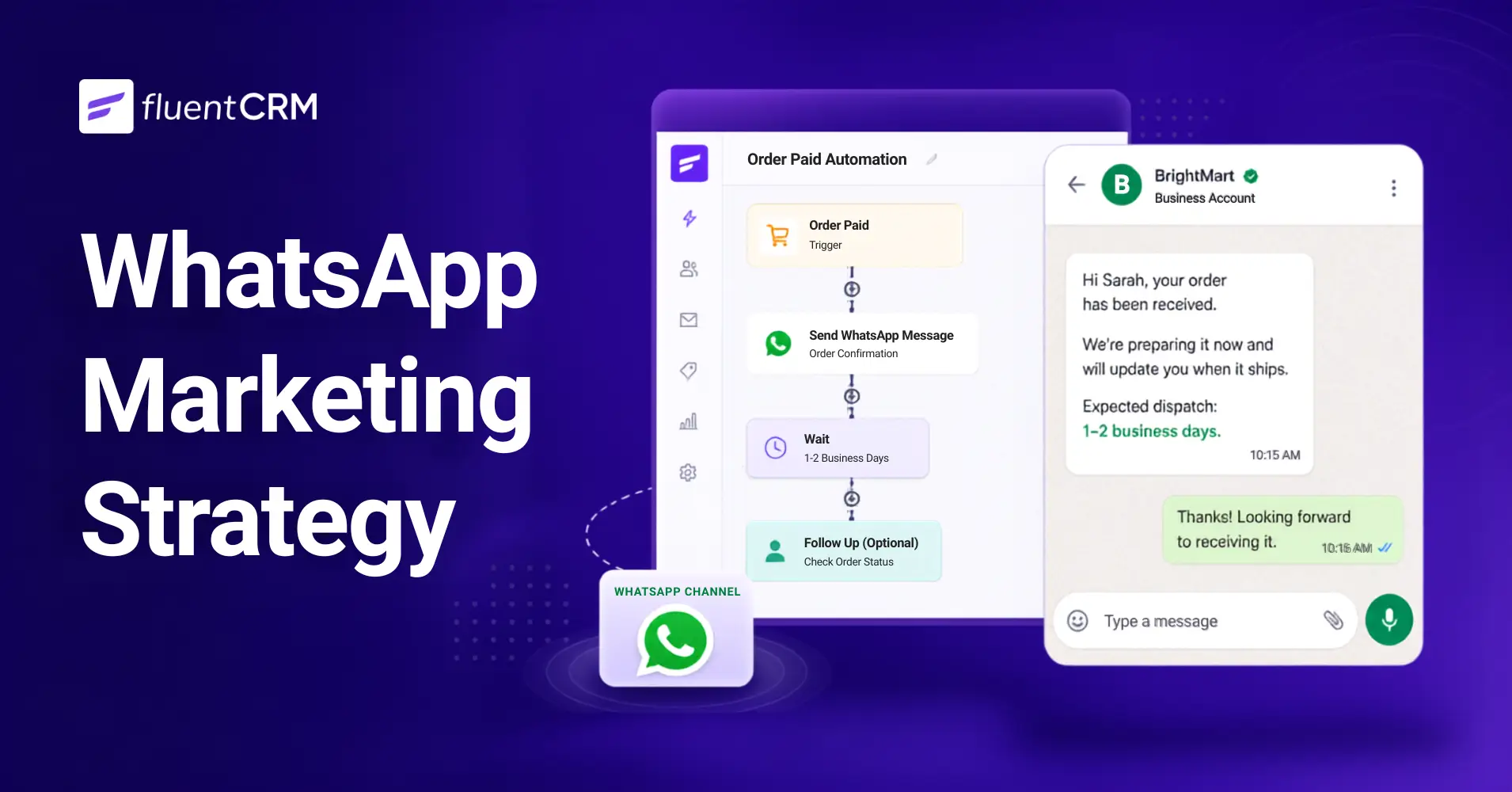
WhatsApp Marketing Strategy: A Complete Guide for Businesses in 2026

Summarize with


Last Updated:
Some customer moments need more than email.
A purchase confirmation, an important update, or a quick question can lose its value when it sits unread in an inbox. SMS can deliver these messages quickly, but it offers limited room for conversation and context.
WhatsApp fits between the two. It gives businesses a direct, conversational channel for sending timely messages, automating important touchpoints, and continuing one-to-one conversations with customers.
But an effective WhatsApp marketing strategy involves more than sending another promotional message. You need to know which conversations belong on WhatsApp, how it should work alongside email, and how to communicate without overwhelming the people who trusted you with their number.
What is WhatsApp Marketing?
WhatsApp marketing is the practice of using WhatsApp to communicate with customers who have agreed to hear from your business. These communications can include:
- Sending broadcast messages to targeted segments
- Triggering automated messages based on customer behavior
- Managing two-way conversations with customers
WhatsApp is particularly useful when timing or conversation matters. Instead of waiting for someone to notice an email, you can deliver a concise message through a channel they are more likely to check throughout the day.
Why WhatsApp Marketing Matters?
WhatsApp is the most-used messaging app in the world, with Meta reporting over 3.3 billion monthly active users globally. Here are some factual reasons every business should integrate WhatsApp messaging within their marketing:
- Industry benchmarks published by messaging platforms like Infobip and AiSensy consistently put WhatsApp open rates above 90%, far above the 20 to 25 percent typical of email.
- Meta and third-party research groups estimate well over 200 million businesses actively use WhatsApp Business tools each month.
- WhatsApp is the dominant messaging app across most of Latin America, South Asia, the Middle East, and much of Europe, markets where email has historically underperformed as a marketing channel.
For most businesses, WhatsApp matters because it’s a channel most competitors haven’t systematized yet. A structured WhatsApp program, tied to the same customer data already sitting in a CRM, is still a differentiator in most niches.
None of that means WhatsApp should replace email or SMS, though. It means learning where it fits alongside them.
WhatsApp vs. Email vs. SMS: Choosing the Right Channel
The best marketing teams don’t rely on a single messaging channel; they use each where it performs best. Email, SMS, and WhatsApp each have different strengths, and understanding those differences helps you deliver the right message at the right time.
| Channel | Best for | Why |
| Newsletters, educational content, nurturing sequences, and detailed announcements | No length limit, rich formatting, searchable inbox, ideal for nurturing | |
| Timely updates, campaigns, automation, and individual conversations | Near-instant open rates, feels personal, supports real-time replies | |
| SMS | Simple, universal alerts to contacts without WhatsApp or app access | Works on any phone, no app required, reliable fallback for urgent messages |
A simple way to think about it is:
- Email provides depth.
- WhatsApp supports speed and conversation.
- SMS provides broad reach.
For example, you might introduce a product through email, send a short WhatsApp campaign when it becomes available, and use SMS only for contacts who cannot receive the WhatsApp message.
The next question, then, is when should your business choose WhatsApp over email or SMS? Let’s look at the scenarios where it makes the biggest impact.
When Should You Use WhatsApp?
Some message types clearly benefit from WhatsApp’s speed and read rates. Others are better suited to email’s depth or SMS’s universal reach.
| Scenario | Best channel | Why |
| Appointment reminders | Time-sensitive, benefits from a fast reply to confirm or reschedule | |
| Order confirmations | Customers want immediate, unmissable confirmation | |
| Shipping notifications | Same urgency as order confirmations | |
| Product launches | Email (+ WhatsApp for VIP segments) | Needs visuals and detail; WhatsApp works as a fast follow-up nudge |
| Weekly newsletters | Long-form, not time-sensitive, no reason to interrupt a personal inbox | |
| Educational email sequences | Needs length and formatting WhatsApp doesn’t support well | |
| Customer support conversations | Real-time back-and-forth is the format’s core strength | |
| Review requests | WhatsApp or Email | WhatsApp gets faster responses; email works if timing isn’t urgent |
How WhatsApp Marketing Works
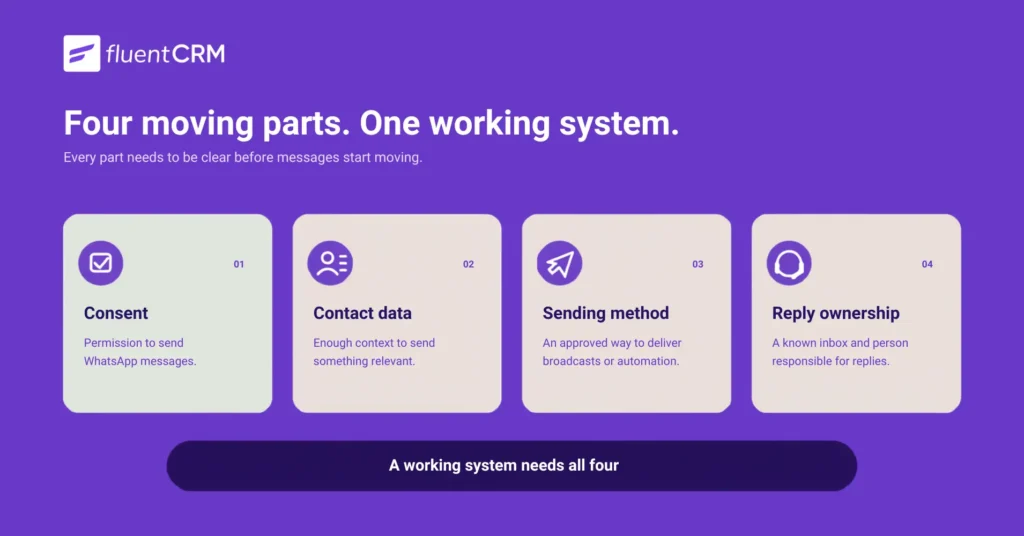
A working WhatsApp marketing system has four moving parts:
- Consent: The contact has agreed to receive WhatsApp messages from the business
- Contact data: The business knows enough about the contact to send something relevant
- A sending method: The business can deliver broadcasts, automation messages, or individual messages through an approved WhatsApp setup
- Reply ownership: Someone knows where replies arrive and who is responsible for answering them
Once those foundations are in place, the actual implementation breaks down into three parts. Each serves a different purpose.
Broadcast Messaging
WhatsApp broadcast messages send one campaign message to a defined group of opted-in contacts. It follows a similar structure to an email campaign, but the message is usually shorter and designed for conversations. Broadcast campaigns can work well for:
- Product launches
- Flash sales
- Restock notifications
- Event updates
- Seasonal promotions
- Relevant service announcements
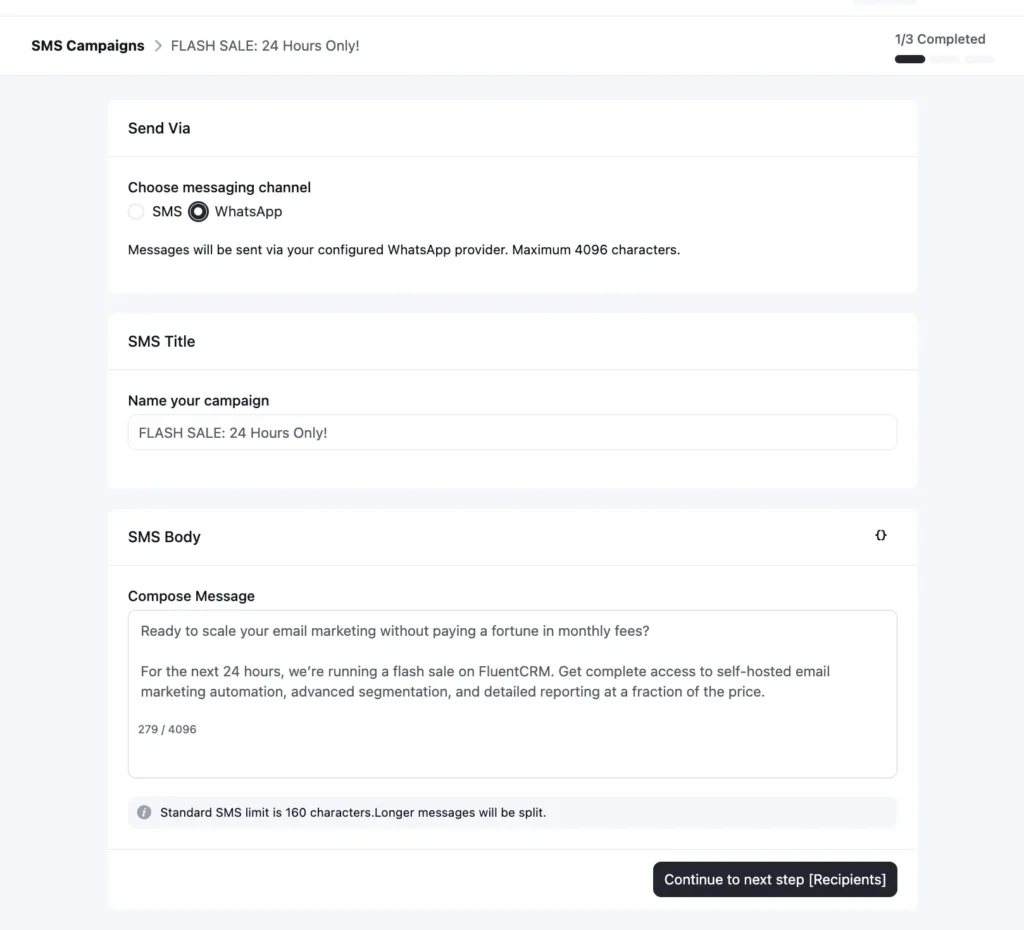
But don’t broadcast daily promotional messages or generic blasts to your entire list. Over-broadcasting is the fastest way to drive opt-outs and trigger Meta’s quality rating penalties.
In general, when a customer messages a business, it opens a 24-hour customer service window during which the business can send free-form replies. Outside that window, business-initiated messages generally require an approved template.
The template submission process depends on the provider. For example, Twilio users create and submit WhatsApp templates through the content template builder.
Behavior-Triggered Automation
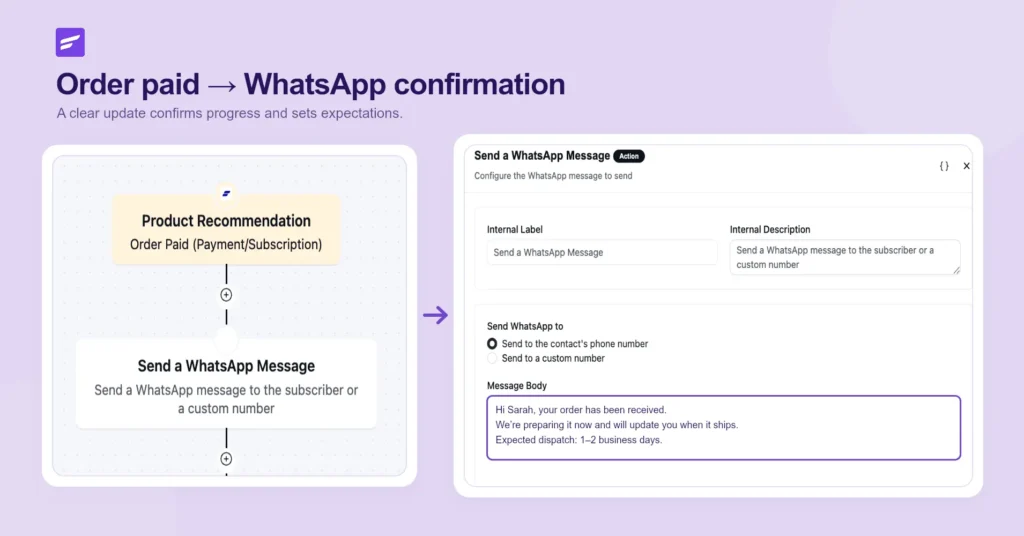
Campaigns are planned communications, automation sends a message when a customer reaches a particular point in the customer lifecycle. The value of this is that the message arrives when it is most relevant.
Here’s how the outcomes change:
| Customer moment | Possible Communication gap | Outcome a timely WhatsApp message can support |
| A purchase is completed | The customer may be unsure whether the order was received or what happens next | Confirm progress by sending a text and set clear expectations |
| A form is submitted | Interest may fade while the contact waits for a response | Instantly acknowledge the inquiry with a text and maintain momentum |
| A booking is created or changed | Important details may be missed or misunderstood | Make the current status and next step clear with a text |
| An enrollment or membership event occurs | The contact may need guidance relevant to that stage | Deliver useful information the moment it becomes relevant |
Across all the moments, the business impact is the same. Customers get informed without anyone needing to tell them, right when it’s most likely to matter. This reduces routine status questions, maintains momentum, and creates a more consistent experience.
Two-Way Conversations
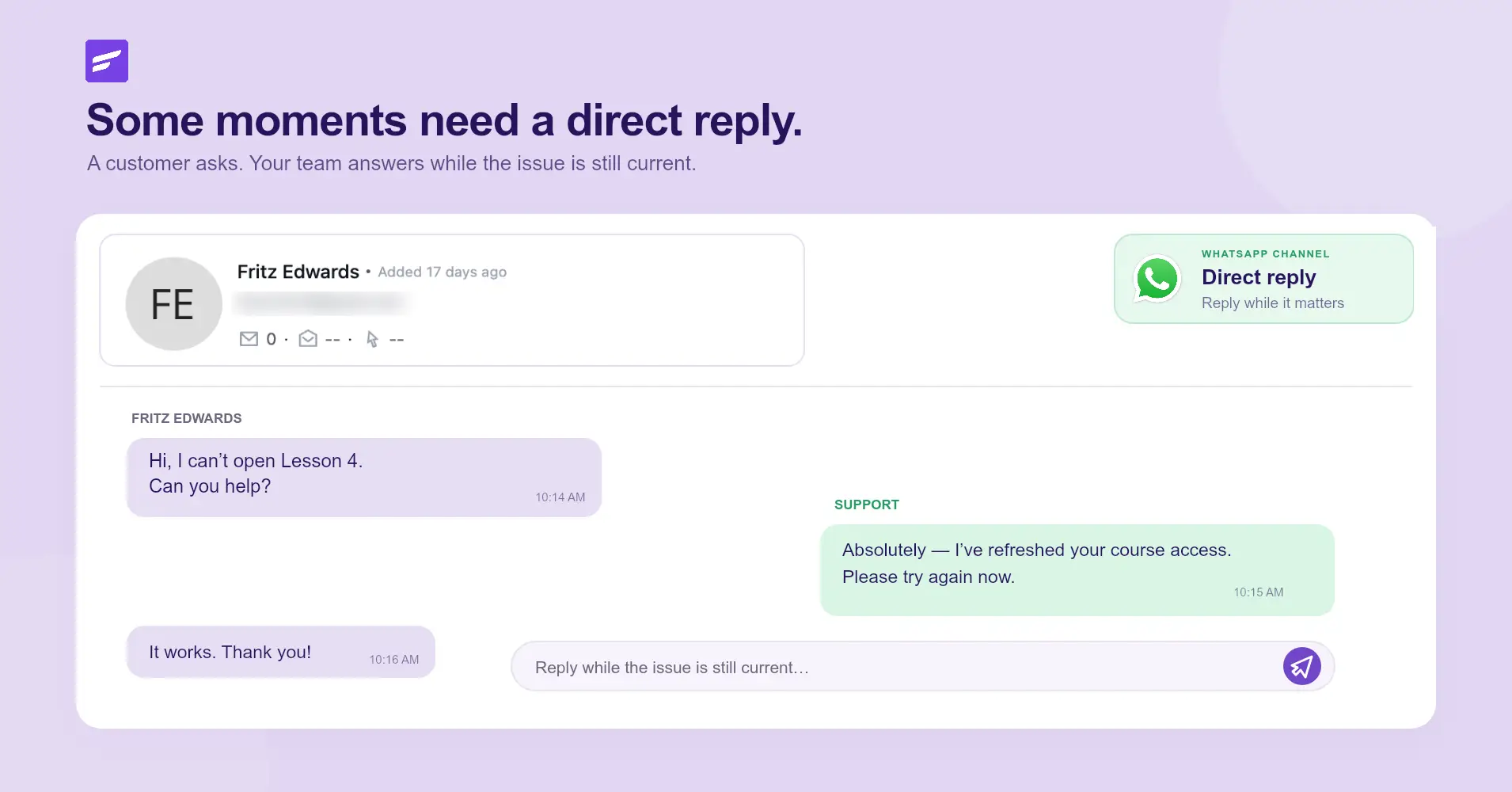
Not every message belongs in a campaign or automation. A student may be unable to access a lesson or a shopper might want to confirm a product detail before making the purchase.
These moments call for a direct reply rather than an automated response.
This is where WhatsApp differs most from campaign-led email. The recipient can ask a short follow-up question in the same channel, and the business can respond while the issue is still current.
Done well, it produces real business outcomes:
- Clearer booking communication: Customers can clarify details or request changes before confusion affects the appointment.
- Stronger sales momentum: Prospects can get answers while their interest and buying context are still fresh.
- Fewer unnecessary escalations: Simple questions can be resolved directly instead of becoming separate support requests.
- More responsive customer relationships: A relevant human response shows that the business is listening rather than simply delivering automated messages.
- Fewer abandoned decisions: Customers with pre-purchase questions have another opportunity to get the information they need.
One-to-one messaging is not a complete helpdesk or ticketing system. Its value is the customer context: the conversation remains associated with the person your team is communicating with instead of becoming an isolated message in another tool.
How to Build a WhatsApp Marketing Strategy
A useful strategy does not start with “send more WhatsApp messages.” It starts with one communication problem worth solving, then builds the smallest reliable workflow around it.
Start with an Outcome
Choose a customer moment where a timely message could make the next step clearer. For example:
- Help a newly enrolled student find the first lesson
- Confirm that an order was recorded and explain what happens next
- Give a qualified prospect a direct way to ask a pre-purchase question
Define the outcome in observable terms. An “improve engagement” outcome is vague. “Increase the percentage of new students who open the first-lesson page” gives the workflow something concrete to support and measure.
Confirm Consent and Define the Audience
A saved phone number is contact data, not permission. Do not import every phone number in your CRM and treat it as a WhatsApp audience. Contact information and marketing permission are not the same thing.
You might collect consent through:
- A checkout or enrollment form
- An account or membership form
- A dedicated signup page
- An existing customer preference center
Record how and when each contact opted in, what messages they agreed to receive, and how they can opt out. Make it easy for people to opt out, and honor those requests across future campaigns.
Keep Segmentation Simple
Segmentation helps you send a message only to people who have a reason to receive it. You do not need dozens of groups. Start with the information that directly affects the message:
- Course or enrollment status
- Product purchased
- Customer type, such as first-time or repeat buyer
- Membership level or status
- Interest in a specific topic or offer
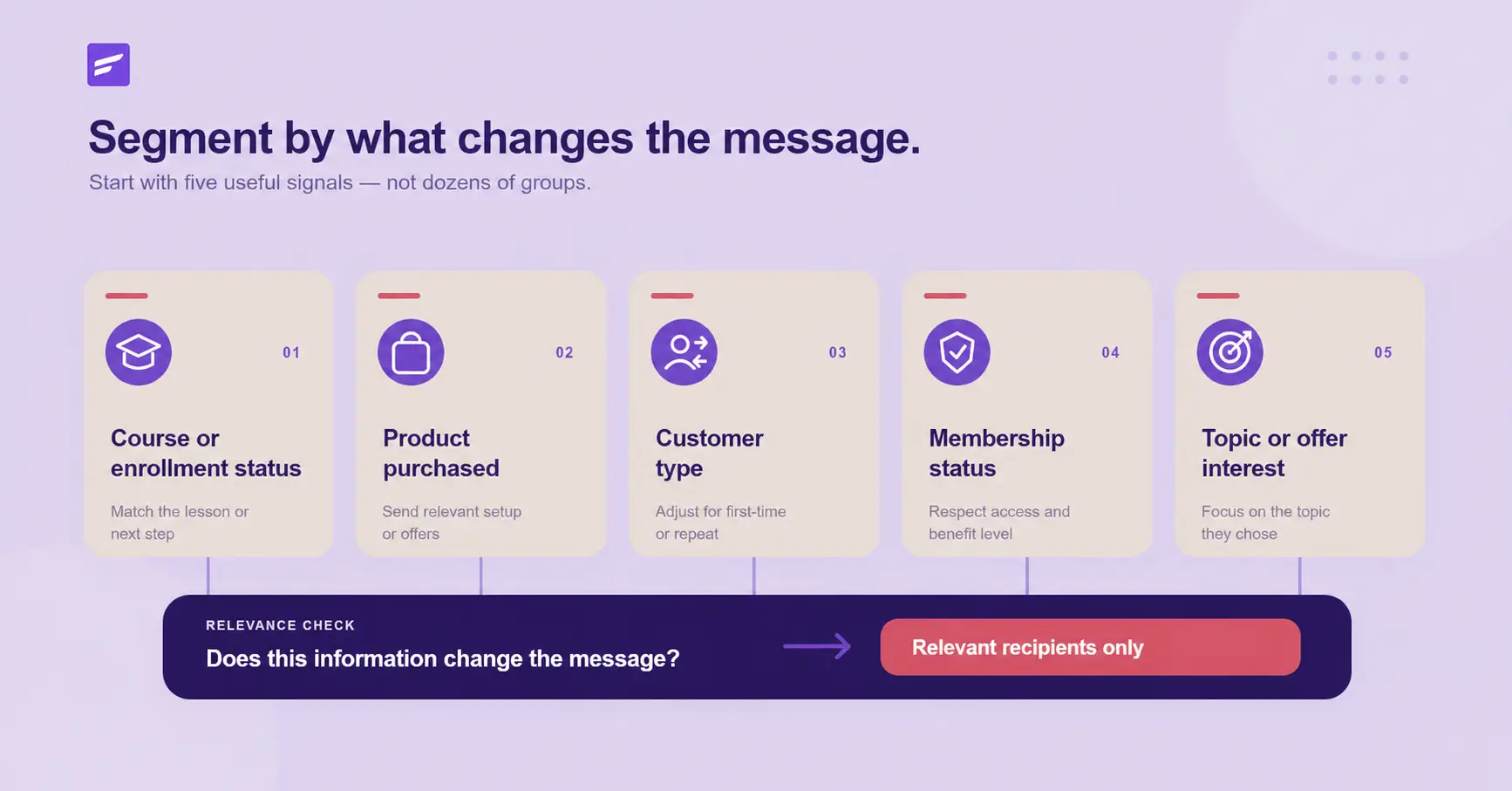
The principle is the same as contact segmentation in other channels. So if you have an e-commerce store, you can reuse relevant customer segments rather than building an unrelated WhatsApp-only list.
A useful segment answers one question: why does this message belong to these people?
Answer that, and you have a perfectly functional segment!
Choose the Right Message Type
Start with useful messages before adding frequent promotions.
Good first campaigns include:
- A welcome or next-step message
- A relevant launch announcement
- A short review request
- A direct reply to a customer question
Keep each message focused on one idea and one next step. For example, if someone just started a course, the message could be:
“Your enrollment in Course Name is confirmed. Start with the welcome lesson here: [link]. Reply if you have trouble getting in.”
That is enough. The full course instructions can remain on the onboarding page or in email.
If the message requires context, explanation, or content the recipient may need to revisit later, link to a page or use email for the detail. WhatsApp should carry the timely point, not a compressed version of an entire guide.
Decide What to Automate
Automation is useful when the same type of customer event needs the same immediate response.
The event must come from a connected system, and the WhatsApp marketing tool should be able to customize what happens next.
For example:
- An LMS records an enrollment > The tool sends an enrollment welcome email
- A store records a completed order > The tool sends a confirmation receipt
Start with one audience, one message type, and one outcome. Check if the trigger fires correctly, the message reflects the recorded event, replies reach the right person, and opt-outs are respected.
Once the workflow is stable, improve it before adding more sends. Expand only when the first workflow is useful to recipients and manageable for the team.
Compliance and Opt-In Rules
WhatsApp marketing is governed by the WhatsApp Business Messaging Policy. Getting this wrong risks account restrictions, not just a poorly performing campaign.
- Opt-in must be explicit and documented: Meta requires clear, affirmative consent, collected through a web form, SMS confirmation, or in-app prompt, that names your business and describes the type of messages the customer will receive. Pre-checked boxes or consent bundled into general terms of service do not qualify.
- The 24-hour window governs what you can send: Once a customer messages you, you have 24 hours to send free-form messages. After that, only pre-approved templates are allowed until the customer messages again.
- Templates are reviewed and categorized: Templates are reviewed and categorized as utility, authentication, or marketing, each with different review criteria. Marketing templates face the strictest review and are more likely to be rejected for promotional language that isn’t clearly disclosed as promotional.
- Violations carry real consequences. Repeated opt-in or content violations can lower your messaging quality rating, which limits how many messages you’re allowed to send per day, and severe violations can restrict the number entirely.
Make WhatsApp Part of the Journey
WhatsApp gives businesses another way to reach customers, but the channel is most useful when it has a specific job.
Use Bulk WhatsApp Campaigns when one timely message needs to reach an eligible audience. Add the WhatsApp SMS Automation Action when a message should follow a customer event. Use Custom and 1-to-1 Messaging when the conversation needs a human touch.
Then let email handle the deeper explanations and long-form content it was built for. With the right balance, WhatsApp becomes more than another place to send promotions. It becomes a practical part of a connected customer journey.

Nazir Himel
Product Marketing Lead
Hey! I’m an inbound marketing specialist focused on email marketing automation. I love turning complex features into clear, user-centric messaging and when I’m not shaping product stories, I’m experimenting with content frameworks, conversion journeys, and helping others communicate value without sounding salesy!
Table of Content
Related Articles and Topics
-
5 Best Design Tools in 2026 for Designers, Marketers, and Creative Teams
Every design tool wants to be the one app you never leave, and none of…
-
How to Drive More Engagement with WhatsApp Marketing Inside WordPress
You might be sending emails to your contacts regularly. It might be: All of them…