

An Introduction to Email Sequences: Definition, Types, & Examples (2026)

Summarize with


Last Updated:
Email Sequence
An email sequence is a series of automated emails sent in a set order, triggered by a subscriber’s action or a schedule. Each email builds on the last to move a reader toward one goal: onboarding, nurturing, or a sale without anyone sending them manually.
As of today, email marketing is considered the heart of the marketing funnel. It is the highest-performing marketing channel in terms of return on investment (ROI).
But creating an effective email marketing plan, segmenting your audience, sending them personalized emails is quite difficult. So, what is the best method to grow subscribers and make the emails stand out from the rest?
The answer is Email Sequence.
What is an Email Sequence?
An email sequence is a series of automated emails sent out on a schedule to a specific group of subscribers in your email list. These sequences, also referred to as drip emails or autoresponders, are designed to streamline communication and engage recipients over time. They can be triggered by specific actions or scheduled at predetermined intervals, allowing for personalized and timely interactions with your audience.
- Trigger-based Email: Whenever someone takes a particular action on your website or inside your email campaign, trigger-based automated emails are sent to them. For example, a user will get an email if they subscribe to your newsletter or buy something from you.
- Time-based Email: Time-based email sequences contain messages that are sent at preset intervals. For example, you can schedule a time-based email when someone completes a year of being your customer.

Why Should You Use an Email Sequence?
Email sequences can be beneficial for new leads and sales. A well-planned email sequence can lay the foundation for future marketing by nurturing and educating people about your brand. Despite that, only 51% of businesses are using marketing automation.
“An exceptional autoresponder creates a great experience for your first subscriber. And it creates the same great experience for your 10,000th subscriber.”
– Sonia Simone.
That means companies that follow an aggressive email marketing strategy with email sequences have a tremendous opportunity ahead of them. Three key benefits of email sequences are:
Scaling Your Business
Theoretically, your email marketing campaign’s success depends on sending the right email to the right people at the right time. However, you can’t be there every moment of every day. That’s where email sequences can play a vital role. It’s like keeping an online assistant that runs your business even while you’re asleep. You’ll just have to outline your users’ journey only once, and then automated emails will have them involved based on their activities.
Increasing Sales
More fun emails make a better chance of engaging with curious clients and closing the deal since you can mark their complaints, offer them discounts, and run over the profits in your email sequence. It’s just a case of nudging subscribers a little further to close the deal once they start connecting with your emails. Gradually, you become familiar with them, and they begin to trust you. And trust brings sales and cash flow!
Reducing Errors
Tracking leads and sending emails manually creates room for error. Using email marketing automation, you can make a set of standard emails to send out during each customer’s sales journey and set triggers for when they should be sent as part of a streamlined, error-free workflow.
7 Different Types of Email Sequences (with Examples)
Below are the seven most common email sequences successful businesses use. You will not need all of them. Pick the ones that match how people actually move through your business, then build those first.
Welcome Email Sequence
Do you just stroll into someone’s home when you go to visit them?
Of course not! They need to greet you.
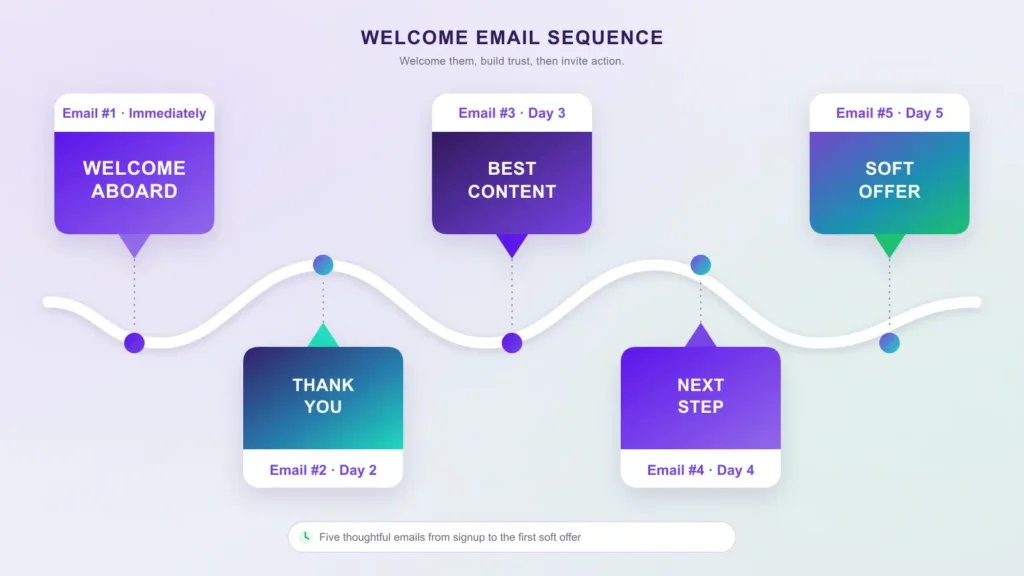
A welcome sequence is the first set of automated emails a new subscriber receives, sent to introduce your brand and set expectations before you sell anything.
This sequence aims to present your brand to a potential subscriber personally. It’s not the correct time to sell anything to them. Your purpose is to make them know, like, and believe you. Introduce your company to them personally, take them on a tour of your best content, and tell them what they need to know to get the most benefit out of your words.
The sequence at a glance:
- Email 1 (immediately): Greet them and set expectations.
Sample subject: “Welcome aboard, {{first_name}}. Here is where to start.” - Email 2 (day 2): Thank them for joining and confirm what to expect.
Sample subject: “Glad you’re here, {{first_name}}. Here’s what’s next.” - Email 3 (day 3): Share your best-performing content.
Sample subject: “The one guide most people read first.” - Email 4 (day 4): Soft invitation to the next step.
Sample subject: “Ready for the next step, {{first_name}}?” - Email 5 (day 5): Make your first soft offer with a clear next step.
Sample subject: “The easiest way to get started, {{first_name}}.”
Finish with a soft call to action (CTA) that inspires them to buy something or move on to the next step in the sales process.
Educational Email Sequence
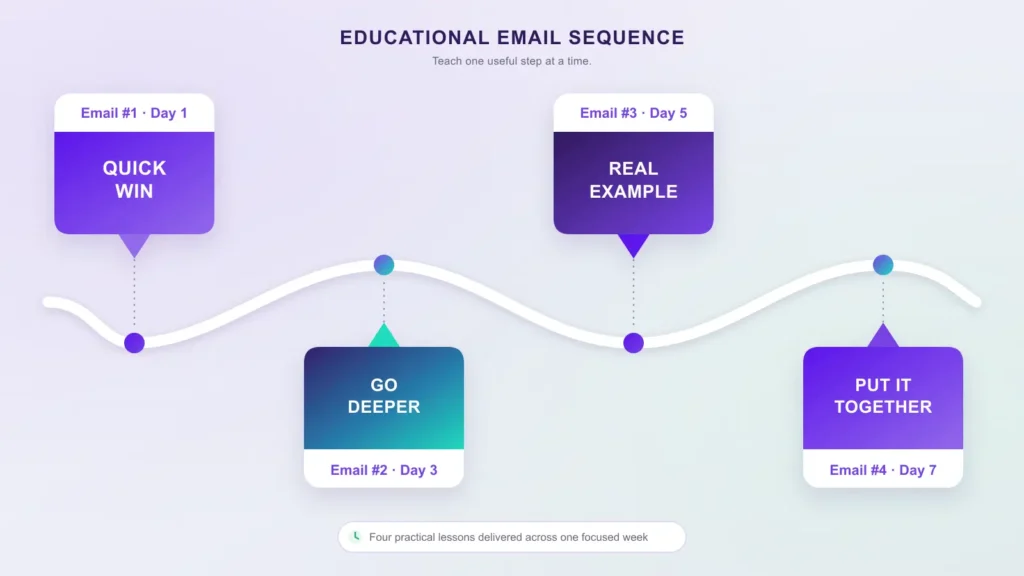
This sequence aims to educate your new subscribers so they get the most value out of your service. An educational sequence delivers a short series of lessons that teach subscribers how to succeed with what you offer.
For example, an app developer shows users how to use various features. A medical office trains patients on how to prepare for their appointments. A law firm educates clients about legal proceedings.
The purpose of this sequence is: you’ll spend less time answering the same questions if you train people proactively with a lesson-by-lesson sequence instead of explaining things one by one.
The sequence at a glance:
- Email 1 (day 1): One quick, five-minute win.
Sample subject: “Lesson 1: the setting most people miss.” - Email 2 (day 3): Build on the first lesson and go a step deeper.
Sample subject: “The step most people skip.” - Email 3 (day 5): Show it working with a real example.
Sample subject: “See {{feature}} in action.” - Email 4 (day 7): Tie the lessons to a result and a next step.
Sample subject: “Put it all together in 10 minutes.”
Space the lessons sensibly so you teach without overwhelming; our guide to email frequency best practices covers the right cadence.
Onboarding Email Sequence
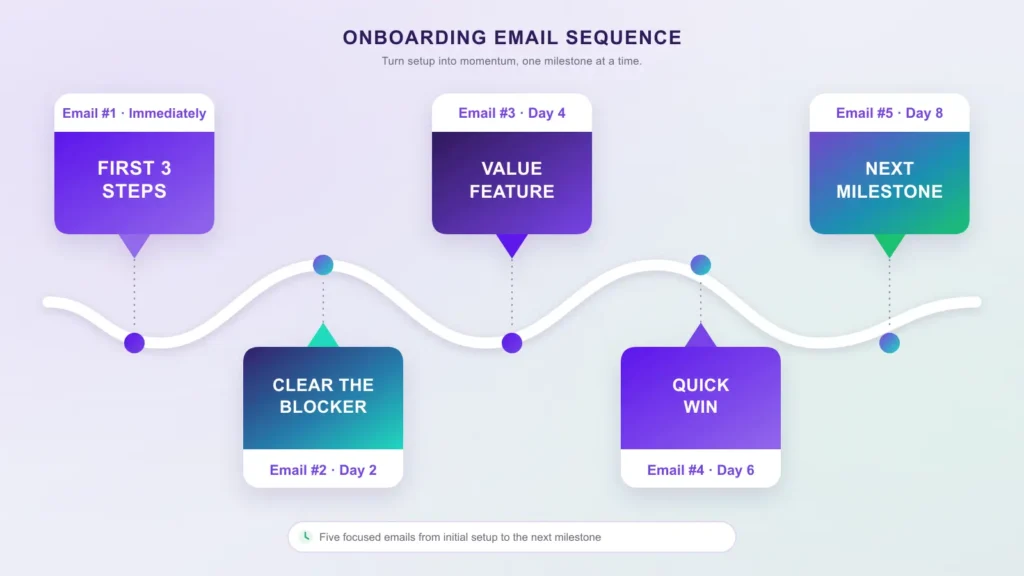
This sequence aims to assist the subscriber in reaching a specified point of value using your service.
The onboarding email sequence ensures new customers learn how to use the product they’ve just bought. Once they know their way around, they get the full value and satisfaction out of it. People get frustrated when they can’t unlock what they paid for, and you want happy buyers who keep paying and recommend you to others.
The sequence at a glance:
- Email 1 (immediately): Confirm setup and the fastest first win.
Sample subject: “Your first 3 steps inside {{product_name}}.” - Email 2 (day 2): Clear the most common blocker.
Sample subject: “Stuck here? Most people are.” - Email 3 (day 4): Introduce a feature that drives value.
Sample subject: “The feature customers wish they’d found sooner.” - Email 4 (day 6): Share a quick win or use case.
Sample subject: “A 5-minute win with {{product_name}}.” - Email 5 (day 8): Point to the next milestone.
Sample subject: “You’re set up. Here’s what to do next.”
Lead Nurturing Sequence
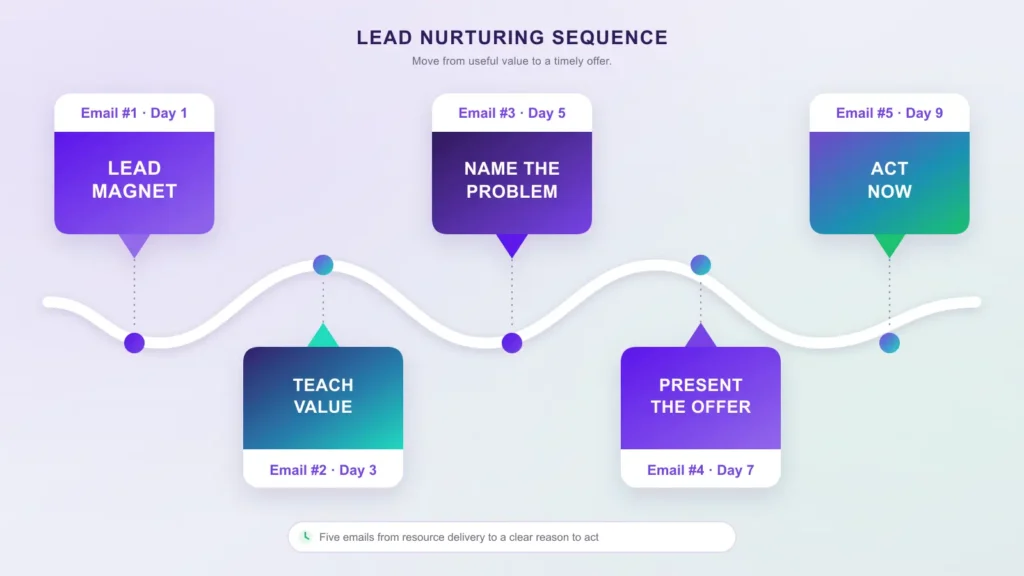
This sequence is all about turning a lead into a paying customer. The lead usually comes from a free subscription or a lead magnet.
When someone signs up for a free guide, webinar, or other lead magnet, this sequence arrives after they’ve digested the content, watched the webinar, or downloaded the guide. A lead nurturing sequence moves from instructional to presenting the offer, resolving objections, and finally closing with scarcity if you have it.
The sequence at a glance:
- Email 1 (day 1): Deliver the lead magnet and set expectations.
Sample subject: “Here’s the {{resource}} you asked for.” - Email 2 (day 3): Teach something useful tied to the topic.
Sample subject: “The quickest way to {{desired_outcome}}.” - Email 3 (day 5): Name the problem and hint at the fix.
Sample subject: “The mistake that quietly costs you {{pain_point}}.” - Email 4 (day 7): Present the offer and handle objections.
Sample subject: “How {{product_name}} handles this for you.” - Email 5 (day 9): Close with a reason to act now.
Sample subject: “Last chance: {{offer}} ends soon.”
Grab ready-made copy from our lead nurturing email templates to fill in each step.
Re-engagement Sequence
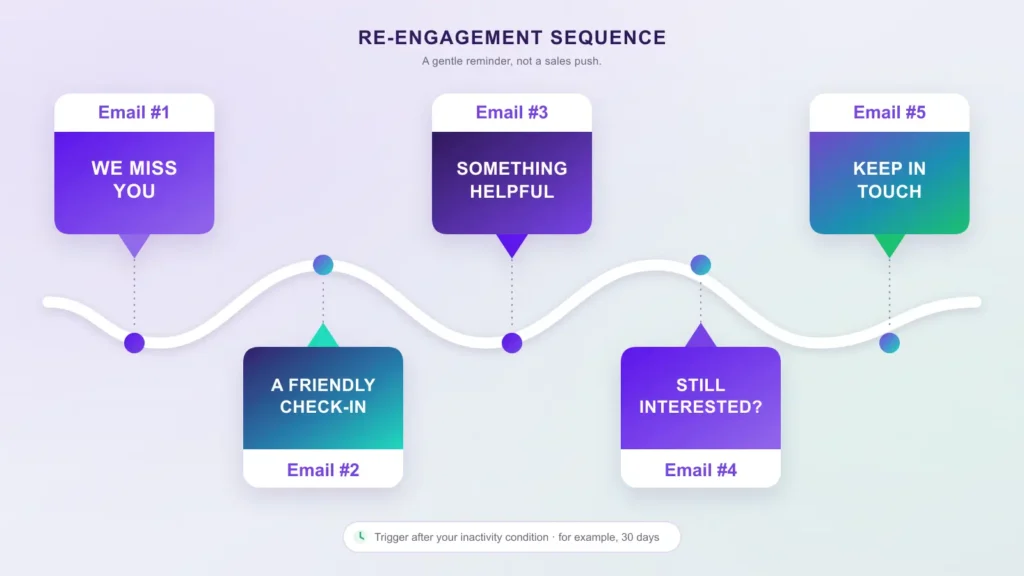
The main goal of the re-engagement sequence is to get your users’ attention and not to push sales.
Sometimes users fall out of touch and require a gentle reminder. A warm, casual message that shows you’ve missed them is often enough to bring lost subscribers back.
This sequence is perfect for showing your once-active subscribers that you’re always around and you still care for them. These emails usually trigger after a subscriber has been inactive for a set period, such as 30 days, and you decide the exact window that marks a contact as inactive.
The sequence at a glance:
- Email 1 (after 30 days inactive): A friendly check-in.
Sample subject: “We’ve missed you, {{first_name}}.” - Email 2 (day 33): Remind them of the value they signed up for.
Sample subject: “Here’s what you’ve been missing.” - Email 3 (day 36): Give a reason to come back, your best content or a small offer.
Sample subject: “A little something to welcome you back.” - Email 4 (day 40): Ask them to stay or update their preferences.
Sample subject: “Should we stay in touch?”
Dive into our guide to the best email marketing sequences for more re-engagement ideas.
Abandoned-cart Sequence
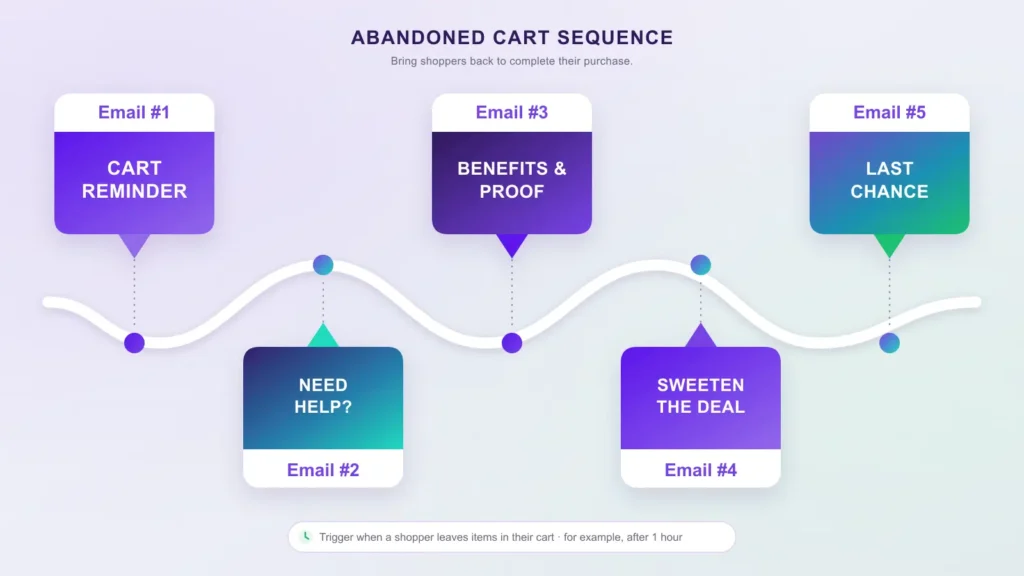
An abandoned-cart sequence recovers shoppers who added items but did not check out. Three emails spaced over roughly 48 hours are enough to remind, reassure, and nudge without becoming pushy.
Start with a simple reminder, handle the usual objections, then make a final, low-pressure call.
The sequence at a glance:
- Email 1 (1 hour): Cart reminder, remind them what they left behind and make it one click to return.
Sample subject: “Still thinking it over, {{first_name}}?” - Email 2 (12 hours): Need help? Offer a hand and remove any friction that stopped them.
Sample subject: “Anything holding you back, {{first_name}}?” - Email 3 (day 2): Benefits and proof, show why the product is worth it with reviews or ratings.
Sample subject: “Why {{product_name}} is worth it (see the reviews).” - Email 4 (day 3): Sweeten the deal, add a small incentive like free shipping or a discount.
Sample subject: “A little something to help you decide.” - Email 5 (day 4): Last chance, a final, low-pressure nudge before the cart clears.
Sample subject: “Last call on your cart.”
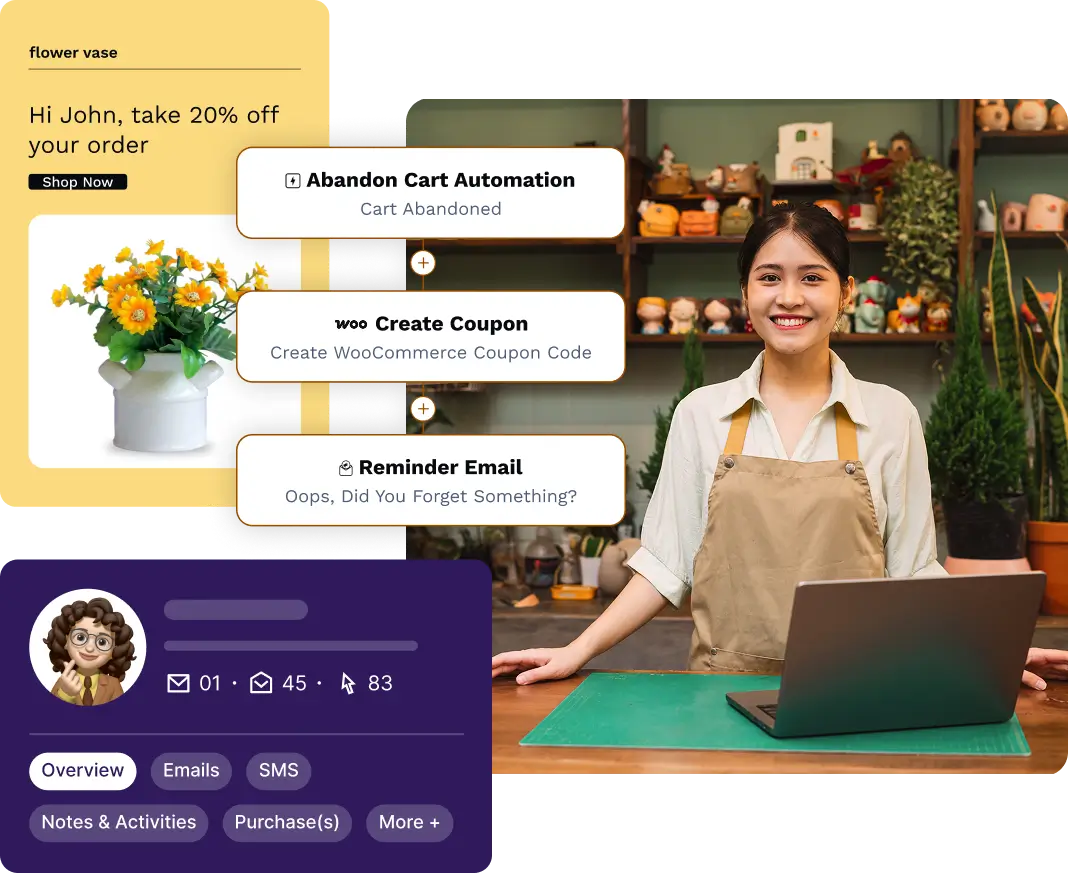
In FluentCRM this runs as a WooCommerce-triggered automation on the “cart abandoned” event, with a goal that removes a contact the moment they complete the purchase.
See it built end to end in our ecommerce automation examples, or set it up from the abandoned cart feature.
Post-purchase Sequence
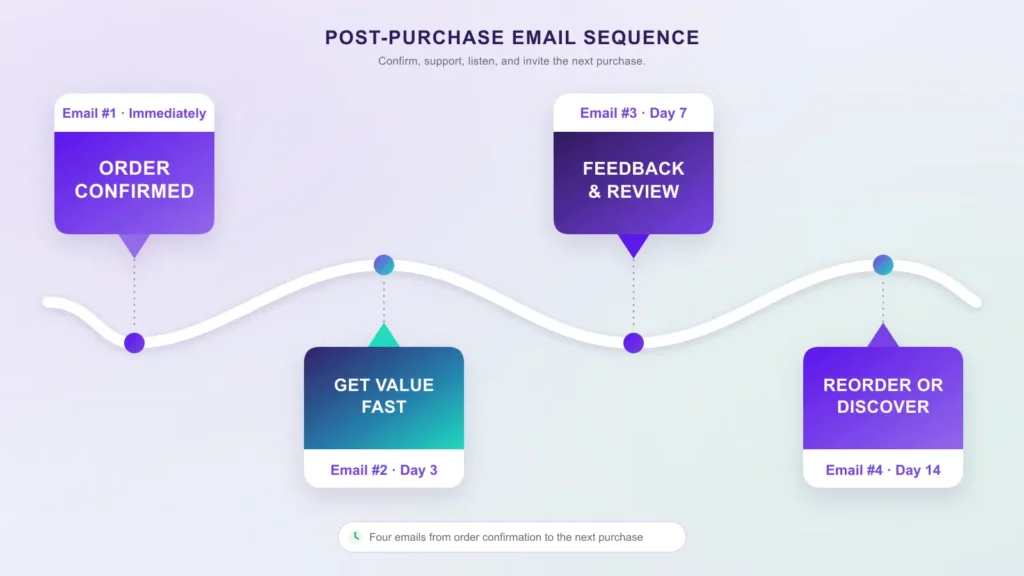
A post-purchase sequence turns a one-time buyer into a repeat customer. It confirms the order, helps the customer get value, then asks for a review or a second purchase once they’re happy. This is where good e-commerce brands earn repeat revenue instead of chasing new buyers every time.
The sequence at a glance:
- Email 1 (immediately): Confirm the order and what happens next.
Sample subject: “Order confirmed, {{first_name}}. Here’s what is next.” - Email 2 (day 3): Help them get value fast.
Sample subject: “Getting the most out of {{product_name}}.” - Email 3 (day 7): Invite feedback or a review.
Sample subject: “How’s it going, {{first_name}}?” - Email 4 (day 14): Cross-sell or prompt a reorder.
Sample subject: “You might also like {{related_product}}.”
For the full build with copy for each email, see our post-purchase email sequence walkthrough.
Start Communicating with Email Sequences!
Now you have all the information you need to create your first email sequence.
You may find it complicated in the beginning. The wiser thing would be to implement the email sequence that best matches your business. See if it’s driving more traffic and turning leads into customers and alter things when required. You’ll get the most out of your email marketing as soon as you start using email marketing automation for your business. Start small and have fun.
Best wishes!
Frequently Asked Questions
Mahmuda Maya
A psychology student who loves to play with words. When she isn’t busy writing, she’s probably busy reading her favorite books!
Table of Content
Related Articles and Topics
-
How to Change the Gmail Profile Picture of Your Custom Email (2026)
Email communication is a vital tool for any business since it’s an opportunity to connect…
-
FluentCRM Email Signature Generator: Create Professional Signatures for Every Email
FluentCRM’s Email Signature Generator is a browser-based email signature builder that creates professional, HTML-formatted signatures…




Leave a Reply